Showing posts with label India. Show all posts

Sunday, January 16, 2011

Curry According to Al

First, my girls are safely in Sydney and will hopefully complete the final leg of their trip home tomorrow. To give you a perspective of how far from here Queensland is, it's two long days or three comfortable days driving. And the girls have paused a few times on their way.

Tonight I am going to present something totally different to my usual fare (pardon the pun).
Quite some time ago I talked about the curries I cook. A couple of people expressed an interest in the recipe. I am cooking curry tonight so I thought I’d bring you along for the ride.
I have written out a rather long winded recipe and taken a few very bad photos as I have progressed to go with my descriptions. It is surprisingly hard to cook and take photos at the same time.
I would say this is not a curry in any particular tradition, rather it is something like the dishes my Indian Granny used to cook. I’ve modified it a bit for ease and to suit local ingredients (the spices are much easier to get here in Oz than they once were).

Curry According to Al.
1 kg (2lb) Cubed meat
2 Large onions chopped
6 – 8 crushed cloves of garlic
1 – 2 inch piece of fresh ginger peeled and grated
4 teaspoons whole coriander seeds
4 teaspoons whole cumin seeds
4 teaspoons of ground turmeric
Ground Cayenne chilli or equivalent
2 cinnamon sticks
12 whole black peppercorns
10 whole cardamom pods
6 whole cloves
Salt to taste
8 tablespoons of plain (natural) yoghurt (alternately a tin of light coconut milk)
8-10 tablespoons good quality cooking oil (I use olive oil which is not at all authentic but any good oil will work)
1 tin diced tomatoes (you can use fresh if you wish)

First a word about the meat: I usually use lamb or beef, but goat or kangaroo both work well. In fact goat meat is my favourite for this dish but I have to go out of my way to get it.
You could use chicken, but I would dial the spices back a little (except the chilli).

Method:
Grind the coriander and cumin seeds. I usually use a mortar and pestle which takes a bit of time (you can use a coffee grinder but don’t expect your coffee to taste right again).

If you have never ground coriander seed take a moment to enjoy the fresh lemony scent when they are cracked, it is simply heavenly. You can substitute pre-ground spices but I would not recommend them. Pre-ground spices very quickly lose much of their flavour and smell. Fresh is best.

Combine with the turmeric and chilli.
With the chilli the trick is to make the amount to suit you palate. If you are a total chilli-wimp half a teaspoon would suit.If I am feeding curry novices I would usually add around a teaspoon of chilli. If you like chilli and are used to hot food two, or three teaspoons would be fine. However I would see this as a fairly mild curry so I wouldn’t go overboard.
To the ground spices add the whole cinnamon sticks, peppercorns, cardamom pods and cloves (you can chuck in a couple of bay leaves as well if you wish).Set this spice mix aside.

Heat the oil in a large heavy pot that you can cover with a lid (DO NOT use a non-stick pan).
Keep the heat high - add the onions and begin to fry.As the onions begin to soften and change colour chuck in the spice mix.
Stir them on a high heat for maybe 60 seconds. Don’t worry if they stick to the pan that is pretty much what you want. Throw in the garlic and ginger and continue to stir.

About this time you will “think this is a real mess”.
Don’t worry, it is meant to be sticky, even caked on to the pan. It should smell really good as the heat activates the spices.

Keeping the heat high, add the meat. Keep it turning as you brown it.
Then as the juices start to come out of the meat use them to help scrape gunk off the pan (I use a heavy wood or bamboo spoon for this).The above piccie shows just how gunky the pan will get

By the time the meat is browned you should have the bulk of the spices scraped off the pan.Add the tomatoes and stir well, keep the heat high until they are well mixed.


Turn the heat down and stir in the yoghurt, one tablespoon at a time.
Alternatively you can use coconut milk. Yoghurt is nicer coconut milk is a bit quicker.

Now add some water (about a cup). If you have used coconut milk you will need less water.
Turn the heat back up slightly and bring the pot to a boil. Then turn it right down to a gentle simmer and cover.
Cook for at least an hour (until the meat is tender), stirring the pot well every ten minutes or so. The longer you cook the meat the more the flavours will infuse the meat. Some people will cook a curry for over 20 hours! I usually cook this dish for between 1 and 2 hours.

When the meat is tender remove the lid and turn up the heat to reduce the mixture a little until the sauce is somewhat thickened.
Add salt to taste and stir in.

Remove from heat and serve with rice.

A word about rice. An Indian style curry should be served with long-grain rice like Basmati.
Add the rice to rapidly boiling water and stir back to the boil.
Rice should not be overcooked 10 – 15 minutes at the boil will usually be heaps. As it gets close keep tasting it until it is just tender.
Then drain and serve, the rice should be light and fluffy and not at all sticky.

So there you go. Curry according to Al.
Hopefully my Indian readers aren’t laughing too hard.

Tuesday, December 7, 2010

Arthur: The Birthday Present Part II.

I ducked into a hollow under the overhanging fringe of lantana. In the shade I stood up.
Then I froze, I stood absolutely still…
Just a yard or so in front of me sprawled out in the cool shade lay a fully grown Bengal Tiger…

She stared at me. I stood rooted to the spot. With absolute terror I realised two things: her massive paws were just in front of me, she could so easily swat me like a fly; I had a gun but as I was painfully aware it was slung over my shoulder.
Not knowing what else to do I stood as still as I could. It seemed an age, but was probably only a few moments. Her huge yellow eyes stared unblinking into mine. Then she yawned, her huge mouth opening wide exposing her huge fangs. My heart jumped, but still I stood as motionless as I could.

Then slowly, almost casually she rose and stretched like the gigantic cat she was.
Again she fixed her eyes on mine before stepping forwards.
Then with her shoulder she pushed me almost gently, but still very forcefully aside as she slid from the shade out into the sunlit river bed.

I stood, not unmoving now because I was shaking like a leaf. Then after a moment I turned and ducked back into the sunlight. The tiger was almost at the opposite bank of the river, strolling towards the jungle.

I swung my gun off my shoulder and grabbed it awkwardly. Still shaking like crazy I brought it up, but probably because I was shaking so hard it discharged harmlessly into the air. The tiger picked up her pace and disappeared under the vegetation that covered the opposite bank.

I stood there watching the jungle she had disappeared into and sighed with relief. Relief because she had chosen not to harm me, but even more relief because my shot had gone wide and had not harmed her. I had brought up my gun without thinking, but as soon as I did I realised how wrong I would have been. For whatever reason she had chosen to spare me, it would have been very poor form to have repaid her with death.

I remained in India for more than another forty years. I went on many hunts, taking game of all kinds.

I should say of almost all kinds; I never hunted tigers after that day.
I decided that I had a debt to tigers that I would repay by sparing them, as she had spared me.

Arthur Russell contemplating a Madhya Pradesh Landscape 1965,
in forty years the area had gone from mostly jungle to predominantly farmland.
There are still Tigers in MP, but they are terribly endangered

Sunday, December 5, 2010

Arthur: The Birthday Present.

The following is a story told to me by my Grandfather Arthur Russell. He told it to me a number of times when I was young. I know he also told it to my father Rupert when he was a child. Arthur was a real story teller and had an amazing ability to bring his experiences to life as he recounted them. This story is told essentially as he told it with little embellishment. The story is about an event that happened in the dry season in 1925. The location was near his family’s hunting lodge which was situated close to a tributary of the Narmada River not far from Jabalpur in what was then Central Provinces and is now Madhya Pradesh.

My father gave me a brand new 20 gauge gun for my sixteenth birthday. As was normal for the time in British India we were a family of hunters. Our house in Jabalpur and our lodge were festooned with trophies. If you have been to my brother Bill’s house you will have seen many of the trophies from those times.
Naturally I was very excited and wanted to try my new gun out as soon as possible. But although I was home from boarding school on holiday I had work to do before my father would let me out.

It was close to noon by the time I was out. It was very hot, as is normal in the dry-season and in reality if I wanted to find something to shoot I would have been wiser to have waited until it cooled a little in the evening.
But I was young and keen, so I ignored what I knew and hurried out as soon as I was allowed.

I headed down to the river because it was the usual way we threaded our way into the thick jungle. Because it was the dry season the river had stopped flowing leaving large standing pools in its sandy bed. I weaved my way along the river bed, leaving a trail of footprints in the dry sand.
As I went, I looked for tracks in the river bed as my father had taught me. Half an hour went by, I had seen nothing and the jungle was quiet except for the throb of cicadas high in the trees. My pulse quickened with excitement as I saw the pug marks of a leopard, but then I realised they were days old. I walked on.

The scenery was beautiful, the thick jungle on either side, and lantana thickets shading the banks of the river. The sun threw dancing reflections off the pools of water.
It was terribly hot, even for a boy who had lived his whole life in India. My gun began to get heavy so I slung it by its leather sling over my shoulder.
But I was not going to give up, so I went on.

Eventually, hot and tired I came to a stop. I stood and thought about what to do. I really wanted to bag something with my new gun. But I finally had to admit I was not going to find anything along the river in the heat of the day. Perhaps, I thought, if I went into the jungle proper I might at least find a jungle fowl. Or if I was really lucky I might bag a peahen for dinner.

My decision made, I turned ninety degrees and made my way to what looked like a lower section of the bank under its canopy of lantana.
I ducked into a hollow under the overhanging fringe of lantana. In the shade I stood up.
Then I froze, I stood absolutely still…
Just a yard or so in front of me sprawled out in the cool shade lay a fully grown Bengal Tiger…
Image: Wikipedia, Wild tiger in Bandhavgarh National Park, Madhya Pradesh

Saturday, November 27, 2010

Rupert: Part I

Last Friday I posted about a love affair. A love affair that resulted in Al entering the picture.

The next consequence of the affair was the entry of my little brother Ian. Thanks to Dad’s dislike of photos this is the only one of Ian as a Baby.

Today I want to talk about my Dad. When I think of him I remember him as something like this.
Still quite young and wearing the beard he has now had for most of his life.
The piccie says so much about Dad. In the photo he is in the bush studying a sand goanna he has caught. Goannas are monitor lizards, in Oz we have 30 species ranging from about 20 cm (8 in) to 2.5 metres (8 ft 2 in). Sand goannas are a middling sized species that grow to about 1.4 metres (4ft 6 in).

Like many people Rupert is an odd mix of contradictions.

He was born into an upper crust family in India. Yet here too there were contradictions. My Grandfather Arthur Russell was a senior police officer, a product of the British Raj (as I have said in previous posts the Russell family's involvement with India began in the 1700s).
Arthur Russell my Grandfather Central Provinces (later Madhya Pradesh) Police

In one momentous way Arthur defied the conventions of the time because he fell in love with Beryl Essai an Indian girl who became my grandmother.
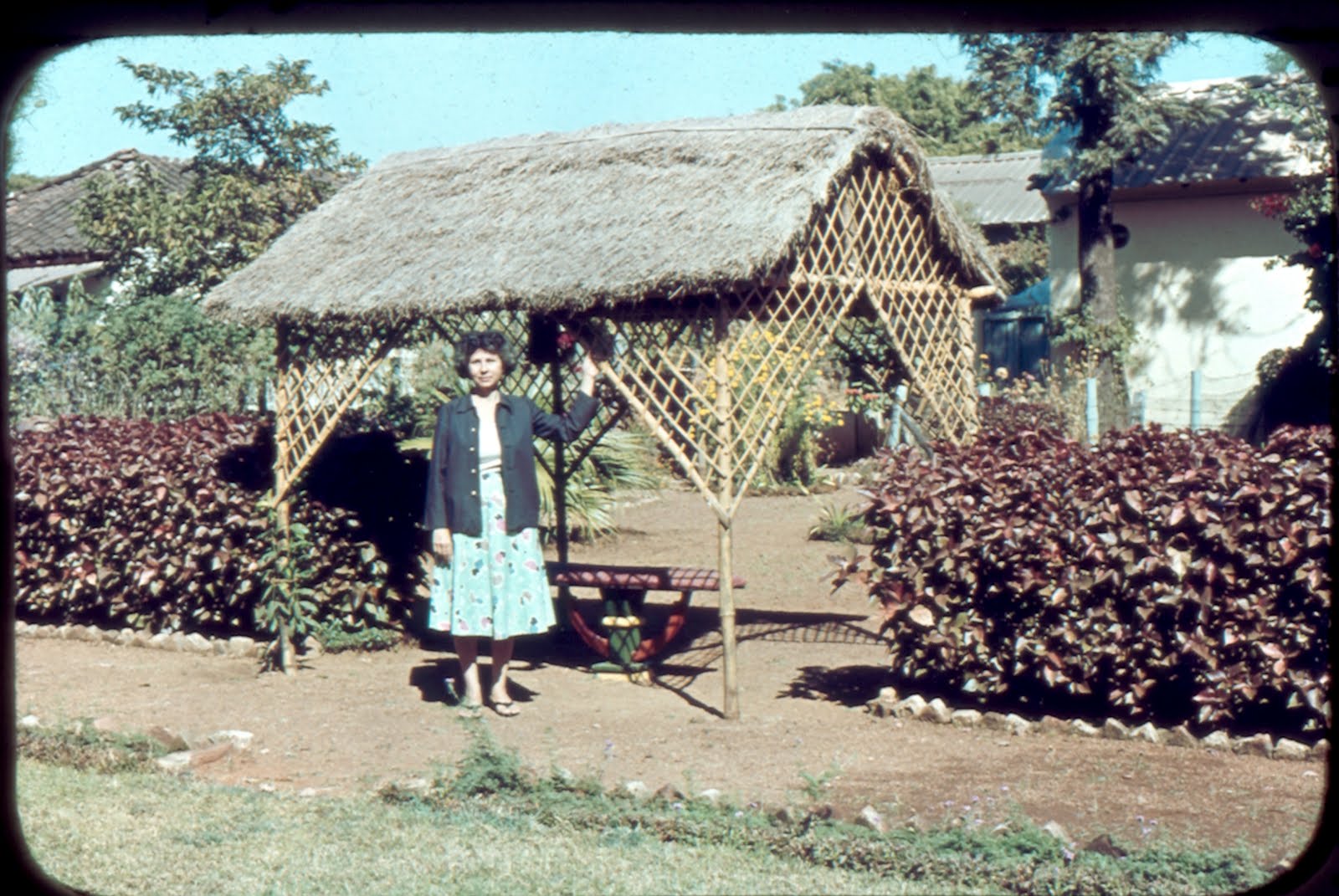
Beryl Essai Russell in her Garden, Madhya Pradesh 1960s
In spite of marrying an Indian woman Arthur was well and truly wedded to the past: to a notion of a powerful Britain with India as a Jewel of Empire.

Perhaps as a reaction to this Dad rebelled, as soon as he could he left India (luckily for me he picked Oz). Once here he went further, becoming a socialist and then a communist in his early 20s. His communism did not last long, ending with Khrushchev's denunciation of Stalin. But his rebellious nature continued as he shifted into the life of a hippy.

The one thing that he did retain that was his father's was a passion for the bush. Although this too changed. The Indian jungle experiences of his youth were those of the Raj, a love of the wild that incorporated hunting, trophies and the like. When he came to Australia this aspect of his character was still intact.

A story my mother tells illustrates this. At one point in Far North Queensland (FNQ) they were broke. Dad's solution was to hunt a crocodile for the valuable skin (today crocodiles are protected in Oz but in the 1960s they were still fair game.) As my mother relates the story Dad stalked as close has he could to a large croc sunning itself on the bank of a river.
Estuarine Crocodile (Salt-water Crocodile)
He aimed his army surplus .303 rifle at the animal and fired. To his frustration the croc disappeared into the murky water.

Then to Mum's alarm Dad dropped the gun and dived in after it. She has always said that was one of her worst moments. She was just pregnant with me, they were right out in the bush and Dad was following a huge crocodile into the water!

She stood on the river bank for what seemed like an eternity and just watched the surface of the cloudy water. After what seemed an age Dad's head broke the surface and he came up dragging the body of the croc by its back leg. Between them they managed to get the animal out of the water and then Mum exploded: “What were you thinking?” she demanded. Dad's response, “I was pretty sure it was dead, I thought it was worth the risk”.
Needless to say Mum put down her foot and that was the last time they hunted crocodile.

Around this period Rupert's attitude to wildlife shifted. He stopped seeing animals as something to be exploited. He always believed in conservation, initially so there would always be wild spaces for people to use and animals to hunt, but now he came to see conservation differently. He came to believe that wildlife and wild places had their own value and should be preserved for their own sake.

Rupert's new views opened new doors, he became an expert in reptiles and later did extensive research on possums in the wet forests and rainforests of FNQ. (American readers should not confuse our possums with your opossums. Ours like yours are marsupials, but there the resemblance mostly ends, we have a large number of species,
Brushtail Possum
from large-cat sized brushtails, to cute mouse sized pygmy-possums there are gliding possums from miniscule feather-tailed gliders to greater gliders which are again about cat sized.)

Perhaps still rebelling, he became a leading conservation activist in the 1970s. Maybe he also drew on his Indian heritage in this as he coordinated a number of Gandhi inspired non-violent protests against developments in places like the Daintree Rainforest (later a World Heritage listed site).

As well as protesting Rupert came up with practical solutions to conservation problems. Perhaps the best example was the concept of linking isolated patches of forest by rope bridges to allow arboreal creatures to cross.

This piccie is of Rupert’s original bridge in FNQ. This original bridge has a tube like hollow box form because Rupert assumed smaller animals would go through the inside to gain protection from hawks and owls (many Oz animals are nocturnal). The concept has been proven through research, although it has been found most animals used the top so recent bridges have been simplified to a single deck. Scattered all up and down the country bridges like this are helping possums and other creatures cross freeways and other man made obstacles.

A quick note about the piccies. Unusually none of these are mine, the older piccies are from family sources, while the wildlife ones are from Wikipedia.

Friday, November 19, 2010

In which Al enters the Picture.

A little while ago I did a post based on my early teen years in Mum’s patch of the country.

I promised I would carry on with more of the story. Well I am starting that story again only… and it is a fairly big only… I am jumping about thirteen or fifteen years further into the past.

The early 1960s a man and a woman meet and fall in love.

He was from India. As an Anglo-Indian in a racist world, living in what was Redneck Australia he was (I think) tormented. She was desperately unhappy in a marriage to a man who would not let her return home to visit her ailing father in England.

They are both married to other people and have children. Yet despite that and despite the standards of the time they leave together. He never looks back, she regrets always leaving her son and daughter with the man she no longer loves.

About two years later I was born…

Meet my father, Rupert Russell. This is what he was like in my earliest memories (and amazingly I do remember these times). He was young and fit and a lover of wild places. But it is almost impossible to find a picture of him in this period. He was a thinker (some might argue a philosopher) and he had some funny thoughts. Like me he was and is a writer (find a small sample here). One of the thoughts he had in this period was that people should not have their photo taken. Hence no photos of him.

And... no photos of me as a baby. Which brings me to this piccie. Mum holds a gate somewhere in western NSW so Dad can drive through. Next to her a two year old Al.This is the oldest picture of me in existence. Don’t I look a serious little fellow?

As I said Dad was a lover of the wilds. He grew up in an India that was still even then largely jungle and learnt a passion for the wild from his father. So one of the things we did when they weren’t moving around looking for work was go out into the bush and camp.

Here is one of the few piccies of my Dad from then. Mum got up and snapped him as he slept. The tousled little head next to his is mine.

A detail I had never noticed before on the car are some packets of dri-tot nappies (diapers). I have always known that the mosquito net in the car window was there to protect my little brother Ian from the flies. He was a tiny newborn at the time of this trip. So he slept in a bassinet in the car.

This little photo of Mum was taken a few days later on the same camping trip.And now a discovery. I have always treasured this photo as one from my early days. I scanned it a few years ago so I could have a copy. But tonight I blew it up so I could look at it for this post and I saw something I had never noticed in the little 2” by 2” print.
Al enters the picture.

Monday, January 11, 2010

Sarah, India and Dawn Starts

No it is not quite déjà vu.

But oddly my post tonight shares a great deal with a similarly titled post of a month ago.

Like last month, and despite the heat of the day, there is a curry simmering on the stove.
Like last time I am going to ramble about my Indian heritage.
And like last month I am going to finish by talking about some graves.

As I have said before, one of the pleasures of early starts, is early finishes. This means that I have time to cook properly before the evening meal. Assuming that is, I am in the mood.

Well tonight I have taken the time to grind the spices (the lemony smell of fresh ground coriander seed is heavenly) and make a proper curry.
I don’t use a recipe but if anyone is interested I could write one out and post it another time.

With the curry simmering I have time to write this post.

As I said last time my Russell ancestors used to live in Jabalpur, MP, India. The world really is small and blogging seems to make it a whole lot smaller.
As a result of my previous post I was contacted by a gentleman by the name of Byram.

Byram lives in Canada but like me he has family ties to Jabalpur and he has an interest in genealogy. He asked If I had heard of Valmay Young’s Indian ancestry website and if I had any relatives left in Jabalpur.

I responded to Byram that my family (the Russells) were in Jabalpur by the 1850s but that if we were related to Russells still living there it was distantly. My Father left Madhya Pradesh in the 1950s (he came to Australia).
My Aunt also left in the 1950s initially to Calcutta, then Bombay and finally Australia in 1980.
The last direct tie my family had with Jabalpur and Madhya Pradesh was when my Grandparents left there in 1967 (also for Australia).
My Grandfather was fairly unusual in that he did not leave India at the time of independence (1947). Although he thought of himself as British he had no other home but India (he was born in Jabalpur, as were his father and grandfather) and he stayed there until after he retired.

The next email from Byram was fairly brief and I quote it in full:
“Hi Allan,
Does this grave in Jabalpur belong to one of your ancestors? Regards Byram”

Byram attached these photos:I responded to Byram - “I don’t know for certain, I would guess that it is very likely to be my Great-Great-Grandfather’s grave.”

William and Anley are family names (which fit the initials). I don’t remember my G-G-Grandfather’s name, but I do I know he was killed outside Jabalpur in a hunting accident at around that time. {As a by the by I posted about my ancestor William Anley who liked playing with matches a while ago }

My Great Grand-Father William Anley Postance Russell, was made an orphan by his father’s death, he was raised by his Grandmother. Interestingly our family has had a strong tradition of including both William and Anley in their names.

My Great uncle was William Anley Rupert Russell. My Grandfather was Arthur Anley Rupert Russell and my dad is Rupert Anley William Russell.

Anley and Postance are surnames from other British families that married into mine, that habit of including relations names is a real boon when tracing family histories.

But the plot (please excuse the pun) deepened.
Spotting the name Postance.
Byram shot back this email.

“Hi Allan.
Very interesting. I wonder if the enclosed grave of Sarah Postance is an ancestor of yours. Regards Byram”
And finally Byram posted:

Hi Allan.
The W A Russell and Sarah Postance graves have the same pattern. They are the only two graves that have this pattern. I photographed the other side of SP's grave but the writing is not visible.


So it seems that, by rambling about curries, India and graves I have more than likely found my distant ancestors.

What a small world.

Wednesday, December 16, 2009

Heat and Cricket at Arthur's Creek

It has been quite hot here today 39 ° C (about 102 ° F) in the City and 41° (106°F) out here to the north.. So once I finished work I just came home and stayed indoors. 40 -41° are not uncommon summer temperatures here. We got as hot as 47° (117°F) last February, which was a record for Melbourne. The Bureau of Meteorology is saying we may top 50° (122°F) this coming February, If they are right I am not looking forward to it. It will cause a lot of people a lot of problems.

Melbourne City Council will be running emergency heatwave programs this year. I attended a briefing last Thursday because homeless people are one of the at risk groups in heatwaves.

Now to change the topic entirely (don’t I jump around a lot) I am going to return briefly to Arthur’s Creek. Phil at Walk Talk Tours asked a rather odd question after reading my post on the Cemetery there and I quote “Are you related to the former England wicketkeeper, Robert Charles 'Jack' Russell?”

My answer to Phil was “I'm probably not related to Jack Russell. I do have ancestors from Gloucestershire but they are on my mum's side. The Russell side of my family left England for India over 150 years ago. Before then they hailed from Jersey, London and Yorkshire.”

But there is a coincidence here, I had been thinking about posting on cricket (a wicketkeeper is a player on a cricket field) and the reason is after driving down from the cemetery I paused briefly to take some photos of the Saturday cricket at Arthur’s Creek.Here the batsman stands ready for the ball as the bowler completes his run up.

In this close up the wicketkeeper is the man with the gloves crouched well behind the batsman. His job is to not only stop missed balls but also to attempt to get the batsman “out” if he makes any of a number of errors.

In this case the batsman hit the ball. It wasn’t a great strike and he probably shouldn’t have “run” because one of the fielders had the ball while he was running and it looked like he would be “run out”(unlike baseball a batsman is not obliged to run if he hits the ball).Fortunately the fielders aim was not what it should be and he missed the "stumps"

I should probably stop there. Attempting to explain anymore will take far too long and get me in hot water with cricket fanatics (like Deb my other half). If anyone is interested in how the game works you can find a description at Wikipedia.

But before I go, one last word. I remember attempting to explain cricket to an American guest at a dinner party. Not only did he struggle with the rules but he could not get that the “pure” form of the game lasts for five days and then is more likely to end in a draw than anything else!

Monday, December 14, 2009

Emma, India, and Dawn Starts

You are going to have to excuse me but I am in a rambling mood tonight.

One of the things that is nice about the work I do is that there are early starts. And no before you all say “is he mad?” I do not enjoy getting up at 5:00am any more than the next person (except of course this has the big plus that my commute time is less than half what it would be if I was going in at more normal hours).

The nice thing is the early finish and time in the afternoon and evening, this gives me the opportunity for all sorts of pursuits.

Often they are mundane, like hanging out a load of washing or mowing the lawn.
But as often as not I am able to use the time more creatively. Last week for example I went exploring with my youngest.

Yesterday, I worked on formatting my book before the house got busy in the evening.
Tonight I am in a culinary frame of mind. I am putting the time to cooking a decent curry. Oddly (or perhaps not oddly in this day and age) although I am an Aussie I also have a large chunk of Indian Heritage . My father’s family took a rather long (over 150 years) detour via India on the way to Australia.

As a total by-the-by, if you ever walk through Russell Chowk in Jabalpur a city in Madhya Pradesh India, you are close to some of my family history. If you do a Google you might discover that the Chowk (square) is named after Bertrand Russell, but in fact it isn’t. It was named for one of my ancestors considerably before Bertrand was famous. But that is another story, one I might put into a book… someday.

In the spirit of rambling I am going to jump to an entirely different topic. On Saturday as is our wont we went for a drive. This time we struck out along a road we haven’t used before though Arthur’s Creek. Up on a hill before you reach the village is an old cemetery.
I love cemeteries, they are such a vivid store of the culture of their time. Such a prompt for imagination.

This grave for example speaks of a tragedy, a young woman burying a much loved husband. Clearly at the time Emma, no doubt in love and grief stricken at the loss of her Harry could not imagine resting anywhere else. She has bought a double plot so one day she could sleep alongside her dear one.
Yet a hundred years later there is no sign that she was laid here. No headstone for Emma here.
What happened, the writer in me wonders. As her grief passed did she come to love another? Does she now rest alongside a second husband?
Who knows, but my mind races away across the valley below, thinking of other stories that perhaps one day I could write.Too many books not enough years.

Bless you Emma, I hope the rest of your years were joy filled.