Showing posts with label History. Show all posts

Tuesday, March 15, 2011

In Which Al Bangs on

I’m still on about our Tasmania trip.
We packed so much into day six that we took it easy on day seven of our trip.

For the whole day we hung around Tasmania’s capital Hobart. Deb and Lu went shopping, while I wandered the streets with my camera.

Hobart is a city of 212,000 and as such has nearly half the population of the entire state.

Founded in 1803 Hobart is one of the oldest Cities in Oz. Like many of our early settlements it began as a convict settlement.

Like almost everywhere in Tassie I loved this town. And like a lot of Tassie it still has a profusion of 19th century buildings.I wandered randomly and snapped away as the fancy took me.

Hadley’s Hotel if the sign is to believed was built the year before my current abode Melbourne was founded. Personally I don’t believe the sign. The fussy exterior screams Victorian period. Maybe the business was established in ’34 and they rebuilt later?

I’m not sure what this building is but the little plaque on the end says it was in 1823 the site of the first service conducted by a Presbyterian minister in Oz. Which kind of suggests the building is older hence the simple Georgian style.

I love architectural details like at the top of this doorway. This carving is in sandstone. The mason who carved this must have been amazingly talented.
This one is probably 1870s or so, looks like ‘Second Empire’ style to me.St Mary’s Catholic Cathedral.And the associated residence.The town Hall.I’ll finish with this fountain in Franklin Square.In the middle of which stands this statue of Sir John Franklin.He was Governor of Van Diemen’s Land (now Tassie) from 1836 to 1843.
He was recalled to England after falling foul of the public service. His ‘crime’?
Trying to introduce humanitarian reforms to the way convicts were treated.

Perhaps because of this humanitarian streak he was fondly remembered by the citizens of Hobart and they erected this statue in memory of him after his ill fated journey to find the North West Passage.
He died lost in the Canadian Arctic in 1847.

Wednesday, March 9, 2011

Tassie Again: Day 6 Continued

Believe it or not this is my third post on our sixth day in Tassie.
We packed so much in on that day it is hard to believe in retrospect.

Our primary destination for the day was the ruined Convict town Port Arthur.

Port Arthur began life in 1830 as a timber cutting settlement. But from 1833 until the 1850s it served as a convict settlement taking prisoners transported from Britain and Ireland and re-offenders from the Australian colonies.

It was an incredibly harsh environment to which convicts dreaded being sent. There are stories of prisoners with life sentences deliberately committing murders to find away out via the gallows.

Transportation of convicts to Tasmania ceased in 1853 and from then until 1877 the town continued to function as a prison.
The prison closed in 1877 and the government tried to sell off the property. Soon after the first of a series of devastating bushfires tore through the site and it was essentially abandoned.

From the 1890s tourists began journeying to Port Arthur to see the ruins.
In 2010 the town was listed by UNESCO as a World Heritage Site.

Now the potted history is done the piccies. I have had huge issues sorting which piccies to use for this post as I took about 500 while I was at Port Arthur.

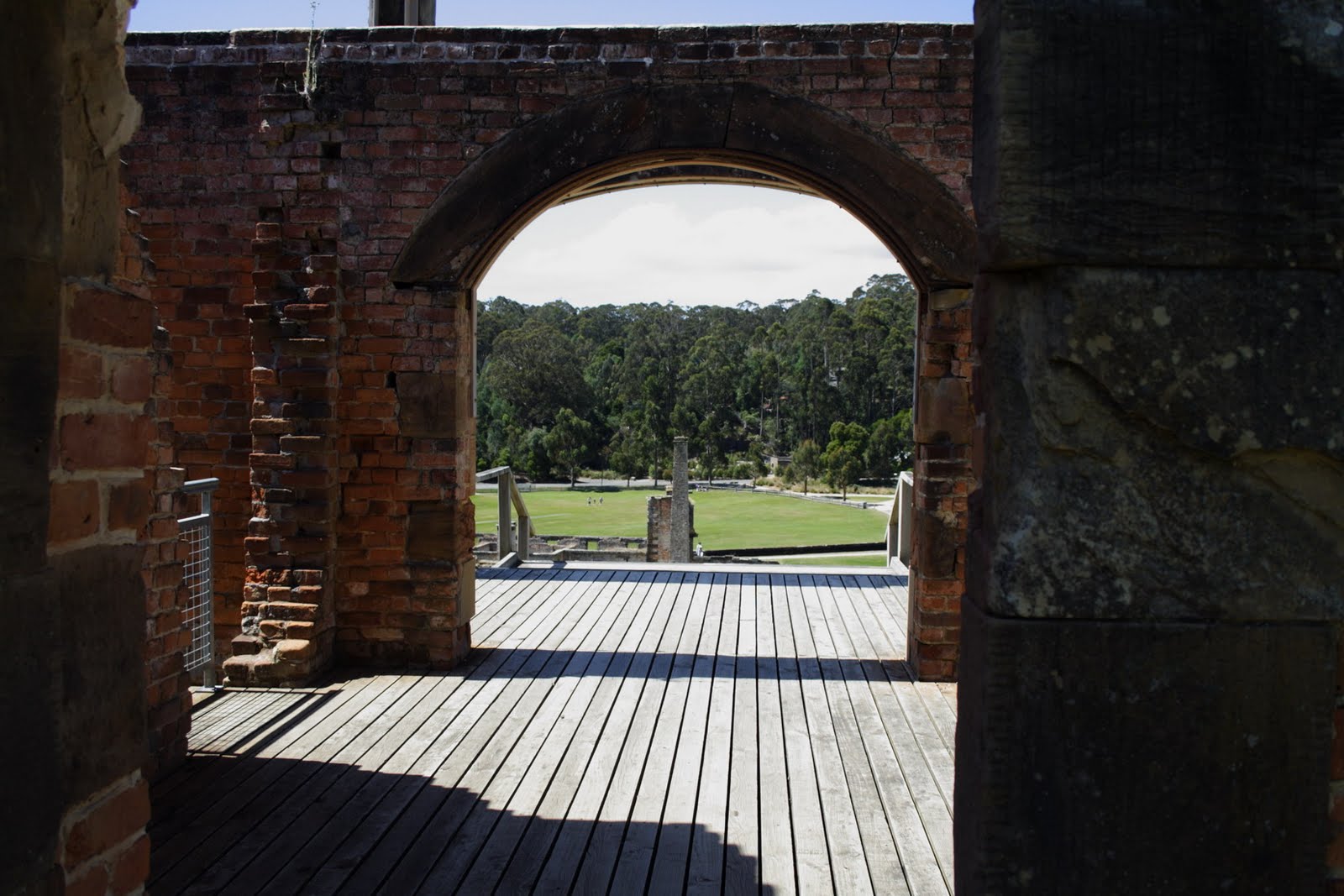
Our first sight of the ruins was across the green to the original prison. It was initially built as a flour mill and store but was soon converted to the prison. Like all the buildings in the town it was built using convict labour.This building just gets more impressive the closer you get. I love the effect of looking through arches and doorways in piccies; this is the tower at the front of the prison.Swinging around the end of the prison you get an idea of how extensive and multilayered the site is.Behind the prison is the officers’ quarters.Dominating the high ground behind is the “Guard House.”And from behind looking down over the bay.The interior of the guardhouse is original as it was one of the few buildings not destroyed in the bushfires. Once again I had fun trying to get decent shots through the building.Directly behind the prison is the hospital.This building was extensively damaged in the first fires.
The government gave it to the Catholic Church to use as a boys’ home.

This photo from the 1880s shows the hospital as it was being repaired.
Another fire left it as it is today.
I played with shots of the hospital’s archways from different angles. From outside:And inside:The north side of the hospital.And below it this massive dry-stone granite retaining wall.We then went for a short ferry ride around the bay.

This is the isle of the dead. It was used as the cemetery of the settlement. There are 1646 graves recorded to exist there, only 180 were marked. Prison staff and military personnel and their families had regular headstones. The convicts were buried in unmarked graves, not even in death was their humanity recognised.

Heading back to the harbour I took some shots from the vantage point of those arriving in the 1800s.A hallway in the "guest house".And last of all I visited the church

Again from inside:and outside:

Saturday, May 1, 2010

Soldier Settlement.

On 11/11/1918 World War One ground to a halt in Europe.

Of the 330,000 Aussies who had volunteered for service overseas 61,928 lay dead and 152,171 had been wounded.
Australian War Cemetery Villers-Bretonneux, France (Wikimedia Commons)

Aussies had fought with distinction in every major campaign.
Yet, what happened to many of our veterans on their return is one of the saddest episodes of our history.

The Australia Diggers returned to in 1919 was facing recession. Many of the Diggers were discharged directly into unemployment.

Not surprisingly, the young soldiers became extremely embittered by the failure of their country to do more for them after they had given so much.

There were no less than 20 serious riots around the country when veterans voiced their displeasure. In a world that was still reeling from the aftermath of the War and the Russian Revolution the State and Federal Governments finally acted to correct their oversight.

Some veterans benefited from training programs to teach them new skills and trades.

Others would be compensated by a shiny new scheme called “Soldier Settlement”. Diggers would be settled on farms around the various states for a “nominal” fee that they could repay over time and they would be given low interest loans to help them get established.

Not surprisingly, thousands of Diggers leapt at the chance to build themselves a future.
Soldier Settler Temporary camp (NSW State Records Office)

Most of them were doomed before they started.

Firstly, most were city slickers with no understanding of farming. Australia had a proud history of “bushmen” and the outback, but in fact by 1900 Australia was the most urbanised nation in the world.
Soldier Settlers clearing land near Mullumbimby (NSW State Records Office)

Then the land that was distributed to the Diggers was either: poor quality land that had been largely ignored by earlier settlers; or going concerns that were split up to provide farms for multiple Soldier Settlers. In almost every case this meant that the veterans were given parcels of land that were never likely to be practicable farms.
Soldier Settler farm Texas, NSW (NSW State Records Office)

Finally, the Australian climate is extremely variable. The normal farming cycle is several good years followed by several years of drought. Experienced farmers could (and still do) make a go of it by preparing for bad years during the good years. In most cases the Diggers had neither the skills or resources to survive the first period of drought which began by 1922.

Soldier Settler Fertilizer Co-operative (NSW State Records Office)

A couple of quotes from NSW state records are typical of the experience of Soldier Settlers.

“We cannot carry on to make enough to keep our wives and family.” Stan Walker 1923.

“As it has been a very dry year here, the water has given out and the cattle are dying.” Clarence Faulkner 1922.

On 13 November 1924, the Police Constable at Ashford reported that Faulkner’s whereabouts were unknown. Clarence Faulkner was one of hundreds of soldier settlers who in the end deserted their holdings.

By 1939 in each state of Australia between 60 and 70% of soldier settlers had left the land, many leaving with debts they could never repay.

These men had in most cases been through unbelievable hardship during the war. More than half of those who returned had been wounded.

Australia repaid many of these men with years more of toil, ending in heartbreak and poverty.

Sunday, January 17, 2010

"Old" Melbourne

I have had an absolutely mad week at work. Over the past few weeks many other services have simply been closed because the Christmas/New Year period coincides with many people’s summer holidays. The spin-off of this is that the numbers of people accessing our services have exploded. We have been having up to 250% of our usual numbers! As a result, I have been coming home a bit too weary to think about posting. Things should ease this coming week as most other agencies such as the Salvation Army homeless service have now reopened.

Now “all work and no play make Jack a dull boy” so I had much of yesterday off and today is all mine! So here I go with a post.

As I have posted before, Melbourne in the mid to late 1800s was the richest city in the world, thanks to the wealth generated by the Victorian gold rushes. The city that is now Melbourne exploded in population and in municipal areas.
In the older suburbs, as well as in the city centre, there remain grand (perhaps grandiose) statements of how much wealth was sloshing around the boroughs of Melbourne in those days.

As you know I love pointing my camera at almost anything. Yesterday I drove around just a few of the older and innermost suburbs of Melbourne to grab a few piccies of the grandest statements of old (should I say oldish? None of these buildings are over 150 years old). I speak of municipal town halls. Here are a sample of 6 of the 24 town halls scattered across Melbourne. Most of these buildings are quite close together, some as little as a good old mile apart (we have used kilometres here since 1975).

Preston Town Hall in northern Melbourne.I took this so close as it is difficult to shoot because of the trees out the front.
This is one of the more restrained buildings. Neo-classical features are at a minimum and there is no clock tower. I love the contrast between the warm bricks and the white stucco.

Northcote Town Hall, again in the north.The painted stucco look is a bit more gaudy but the building is still comparatively simple.

Now we get a bit grander. North Melbourne (formerly Hotham) Town Hall adds a clock-tower to the stucco façade.With amalgamations of municipal councils in recent decades some town halls no longer fulfil their original function.
North Melbourne is one of them.

Fitzroy Town Hall goes all out for the grand imperial statement.
The Neo-Classical look is taken to the extreme. This building would, I expect, feel quite at home somewhere in London.

Like many Fitzroy also had a public library attached to the council chambers.
Just a few blocks across from Fitzroy is Collingwood Town Hall.
The clock tower at Collingwood is as gaudy as they come and I would guess the tallest in Melbourne.

Last, but definitely not least, South Melbourne (formerly Emerald Hill) Town Hall.
Apparently this structure, like Collingwood’s is in “Second Empire” style.
I find the attention to detail of these former craftsmen amazing.Like the capitals atop these Corinthian columns.

So there you have it. Statements from the burghers of old Melbourne about their wealth and power, but also their commitment to Empire.

Monday, November 2, 2009

The Generosity of Others

I spent a long time the other night on the phone to the UK.

As an aside I find that natives of England tend to refer to their homeland as “England”. Whereas in my experience, people from the other lands in the British Isles seem to be as likely to say “I’m from the UK”. They then say as if an afterthought “I’m from…” and insert Scotland, or Wales etc. as necessary. I often wonder what causes the different approach. Surely the Union is not more beloved by the non-English subjects of Her Majesty’s domain.

I’m straying off my point. As I said I was on the phone to the UK. This is not an infrequent event, as I have a much loved brother who resides in Coventry and we talk frequently (as far as I know he was not “sent to Coventry”). On this occasion I was not chatting to my brother. Rather I was talking to a gentleman (and I use the term advisedly) by the name of Don.

Don is in his eighties and is a Royal Navy veteran of WWII vintage. I had the privilege of being introduced to Don (via telephone) by my brother.
For close to an hour Don talked to me about his war time experiences.

Don served on HMS Narborough, a Captain class frigate.
HMS Balfour a "Captain class"
Captain class frigates were built in the US and supplied to Britain under Lend-Lease. The Captain class frigates were named after captains who served in Nelson’s navy. A quick note about the photos on this post, all are available on Wikimedia Commons click on each photo for a link to its source.

Serving on HMS Narborough Don went on the perilous “Murmansk run” to Northern Russia. They went up during winter in atrocious weather and continual dark.
Arctic Noon taken on HMS Sheffield
At one point Don says the sea was so rough that he was seasick 28 times in 24 hours.

He also talked about Exercise Tiger when during a D-Day rehearsal an Allied convoy was attacked off Slapton Sands. The attack resulted in the deaths of 749 American servicemen.
The Slapton Sands Memorial
The disaster was hushed up at the time for fear of compromising the D-Day invasion. As a part of the “hush up” Narborough was dispatched to the middle of the Atlantic and spent the next weeks steaming in circles providing weather reports.

HMS Narborough returned from the Atlantic in the teeth of the gale that almost postponed D-Day. After oiling and storing they crossed to the British beaches with the invasion fleet.
50th Division landing at Gold Beach
Don described having a "ringside seat" while watching the landings.

On D+1 they were off Omaha Beach. When the USS Susan B Anthony was hit by a sea-mine The Narborough was one of the ships tasked with getting 2,689 soldiers and crew off..

Don says it is a heartbreaking experience watching a ship going down. The Susan B Anthony "reared up and then went straight down stern first. Like an arrow fired at a bullseye."
Don was relieved that on this occaision all were rescued without loss of life. However, he added the rescued soldiers were immediately transferred to landing craft and landed on Omaha Beach “without a rifle between them.”

US First Division Troops Landing on Omaha Beach D-Day
Post war Don took up a scholarship to Cambridge University and later worked as an engineer. He is articulate and concerned that his and others experiences are recorded for posterity. As a result he is a mover in the museum dedicated to the Captain class ships. He has also recorded a great deal of information for the Imperial War Museum.

It was in this spirit that he most generously shared his time with me (and offered to not only share more but also to put me in contact with other veterans).

As a fiction writer my main tool is imagination. However, that imagination is stoked and supported by research. I read personal accounts and formal histories endlessly. For WWII history I also can get access to invaluable resources such as photographs and film. Yet, for me, it is always personal accounts such as Don’s that are the most potent spurs to my imagination. Ten minutes speaking with a veteran can be worth a years’ research to me .

Over the years I have been privileged to speak to many people who lived and survived through those years. For most a lot of the experiences are still traumatic, even after all this time, and some can or will say little. In such cases the silences are often as informative as what is said. But some, like Don, are not only able to share the events but do so absolutely candidly. Of course for some the war years were a highlight in their lives, not only a time of privation but also a time of certainty, of shared purpose, of comradeship. Whichever is the case, I am enormously honoured by the generosity of others, in sharing their stories, their memories, and a portion of their lives with me.

So to Don and to all the others I have spoken to over the years, thank you.