Showing posts with label ANZAC Day. Show all posts

Friday, April 25, 2014

ANZAC, Ghost town and a tunnel

Today is ANZAC day in Oz.

Held on the 25th of April it commemorates the day in 1915 when soldiers of the Australian and New Zealand Army Corps (ANZACs) went into action in the ill fated Dardanelles Campaign of World War One.

A mere 14 years after Australian Federation the casualties that fell in that campaign and the rest who fell before the end scarred our fledgling nation. Of a population of just over 4 million people in 1914, 330,000 Aussie soldiers served (all volunteers). Of those 330,000 who served 221,000 were killed or seriously wounded.

Deb and I went for a drive along the Old Glen Innes Road which runs from Grafton one of our local towns up through the Nymboida Valley to Glen Innes.

The road has been bypassed by the new highway further north so it is pretty much in the same state as it was when it was opened in1867.

Much of the way it runs along a cutting perched above the Nymboida River.
At one point where a spur comes down to the river side it dives through a tunnel that was excavated by hand!

I paused at the other end to catch this piccie of a vehicle coming through. To give an idea of the size of the tunnel and just how narrow this old road is.


Further along we turned off up a side track which took us up to "Tommy's Lookout"
 
The view from about 1,000 feet above the river gives an idea of what the country is like. You can't see the road from up there but it snakes along parallel to the river.

The track up to the look out is suitable for 4x4 vehicles only and is not for the faint hearted.
Deb snapped this piccie through the windscreen on the way back down.


Back to the subject of ANZAC day. At the ghost town of Boyd Newton stands a lonely ANZAC memorial.
The local tale is that all the military age men volunteered and not one returned. Whatever happened the village was abandoned soon after, leaving nothing but the memorial.

Wednesday, April 27, 2011

At the going down of the sun…

This Monday past was ANZAC day.

ANZAC day is in many ways the most important day in the Australian calendar.
On the 25th of April it commemorates the day in 1915 when soldiers of the Australian and New Zealand Army Corps (ANZACs) went into action in the ill fated Dardanelles Campaign of World War I.

A mere 14 years after Australian Federation the casualties that fell in that campaign and the rest who fell before the end scarred our fledgling nation. Of a population of just over 4 million people in 1914, 330,000 Aussie soldiers served (all volunteers). It is said that Australian troops had the unenviable record of having the highest casualty rate during that bloody war. What is known is that of the 330,000 who served 221,000 were killed or seriously wounded.

So 96 years later we still commemorate ANZAC day.

The day begins with the Dawn Service. The title of the post refers to an ode (part of a longer poem) which is recited at the service:

They shall grow not old, as we that are left grow old:
Age shall not weary them, nor the years condemn.
At the going down of the sun and in the morning,
We will remember them.

Last year I went to the ANZAC day parade and posted about that.


This year I did not want to battle the crowds so Deb and I made our way into the city in the evening.

It seemed quite fitting that we approached the Shrine of Remembrance as the sun was setting.We approached from the city along the Ceremonial Avenue.When we reached the forecourt the stone of the Shrine was bathed with the rich colour of the sunset. In the forecourt is the Eternal Flame and the World War II memorial.Every instant the light changed. I turned to catch the light painting this white barked eucalyptus orange.Then as the last glow of the sun went…The shrine faded to its usual greyDeb and I turned back to go along the avenue toward the city.Lest we forget how personal these events are…Someone’s private remembrance of a lost Grandfather.

At the going down of the sun and in the morning,
We will remember them.

Sunday, April 24, 2011

Easter and an Extract.

We are being spoiled with a five day break for Easter. Normally there is a four day holiday at Easter with Good Friday and the Monday after being Public Holidays. This year ANZAC day (25 April) falls on Easter Monday so in an Oz tradition there is another public holiday awarded to make up for the overlap.

Now the homeless program I run operates 365 days but my staff usually like to work Public Holidays because they get bonus pay. So I get to take 5 days off straight. Sweet!

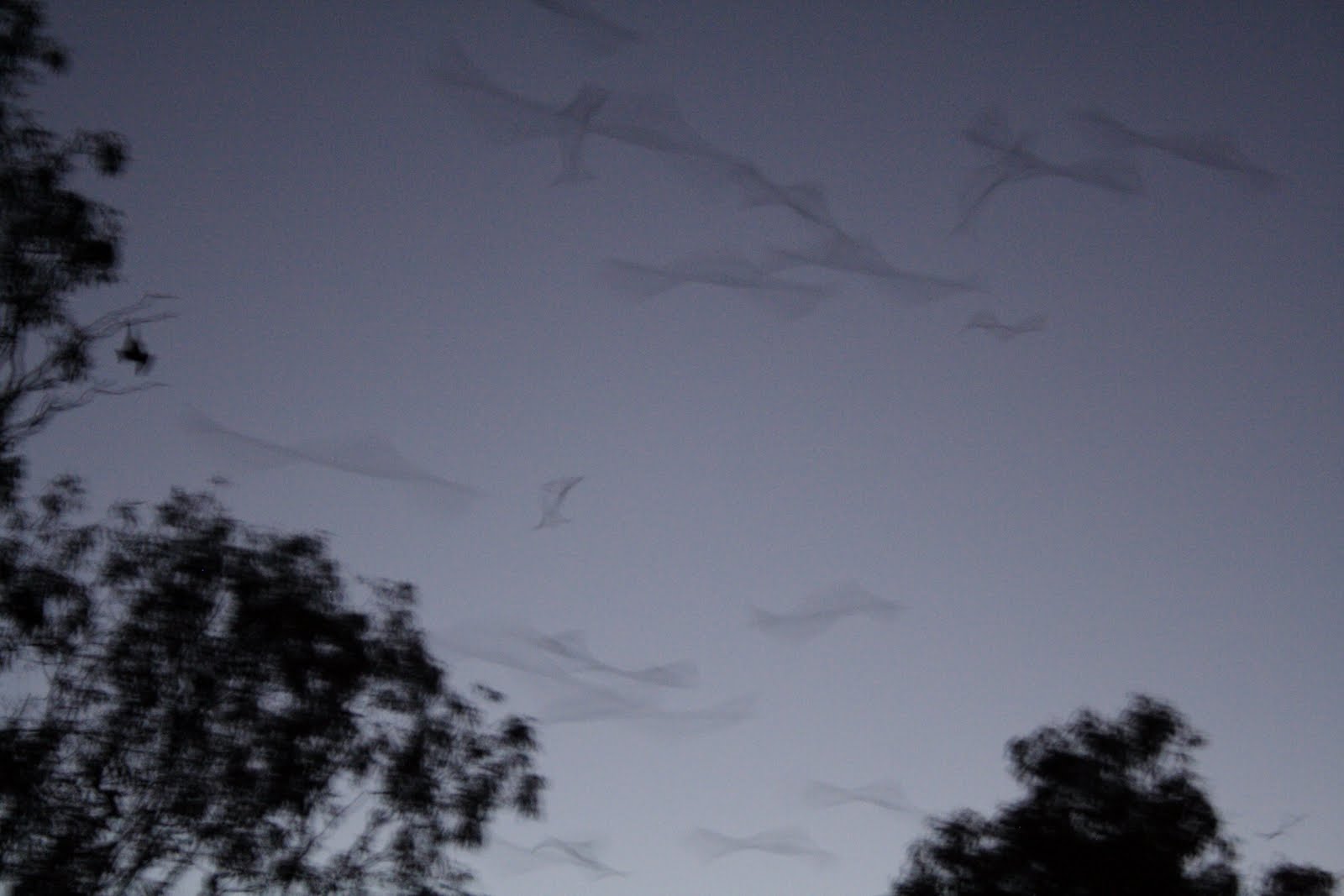
Today we went for a family picnic at the same spot as last week. The little pond was doing an even better job of being a mirror. I just had to share.This evening Deb and I went to have a look at the flying foxes I posted about a couple of weeks ago. Specifically we went to watch them set off for their nights foraging for fruit and nectar. Watching thousands of these beautiful creatures streaming over head was awe inspiring.

I did try to get some shots, but my camera isn’t up to shooting moving targets in the dark. This was about the best I could do. With the new camera I am getting in a couple of weeks I think I should be able to get clear shots of these beauties even in the dark.

Now as is my wont an extract from my WIP Veiled in Storms.
After the ordeal last week Valentina and Penelope escape through the woods looking for safety. Valentina faces an uncertain future…


Valentina Meshcova
Berlin 1948
The guard was a big man in British Army khaki and the red cap of their military police, a huge pistol in a canvas holster on his belt.
I sat half slumped on a mattress against a ply-wood partition wall. We were in a small room at the back of a huge aircraft hanger. Natasha absolutely tired out, lay sprawled along the mattress with her head on my lap.

By now it must have been the early hours of the morning, I was bone weary as well but far too much was racing through my head to allow me any sleep.
I was still dusty from the events of the afternoon.

What an afternoon.
I must have been verging on shock because the rest of the afternoon played like a series of disjointed images in my memory.

The terror of Stepan’s ruse, followed by an unnerving walk through the woods.
Penelope and I taking it in turns to sob nervous tears of relief. Holding to each other and Natasha as we pushed our way through the trees.

Past the trees was open farmland with the houses of an outer suburb in the distance. Crossing those fields felt as terrifying as being under fire. I shook the whole way at the thought of a Red Army patrol coming past. Stepan had said we were walking into the American sector. But for all I knew he was still playing some terrible game with us.

Relief at finding a working phone box near the first group of houses we came to. More anxious minutes as Penelope struggled to get through on the phone.

Not knowing what else to do we hid, waiting behind a hedge until we heard a car coming. I peered through a gap in the hedge as I watched the car, a grey hump backed Volkswagen, slowly approaching. Then as it got near I could see Ronnie was driving. Fred crouched on the passenger seat, clad in army uniform, a machine-gun across his lap.

What a moment, joy and tears and laughter all round. All except Fred who stood with the gun tucked under his arm, scanning the hedgerows for movement.

Finally, a claustrophobic ride across the city with Penelope, Natasha and I squashed together. Hiding again, this time under a blanket in the back of the Volkswagen.

We drove straight into a hanger. They brought us into this little room at the back.
Penelope took Natasha by the hand and led her away; how it tore my heart to see her go. I faced a barrage of questions from both Ronnie and a uniformed officer; Fred standing outside with the gun.

After what seemed like hours they relented. The strange officer stepped out. Ronnie, gave me a half hug, but he seemed distracted, distant, 'I’m going to have to leave you for a bit. I've a hell of a lot to organise, then we'll get you on a plane.'
'What's going to happen to me?'
'It's alright Val, we'll sort it all out. But really I have to go, it's going to be a bun fight to organise a special flight.'

Then he was gone, leaving the guard in his place.

My head spun, I was as powerless now as I had been that afternoon. I had no choice but do as I was told.

How uncertainty for the future undermines a person.

My anxiety eased just a little as Natasha came back in with Penelope. Penelope, looked at my expression, measuring me. A warm sympathetic smile. She pulled me close, 'It will be alright Val. I've always said it will all be fine in the end.’
She brushed futilely at her filthy dusty clothes, ‘Now on a more practical note I am going to get a change, I'll bring you back something clean as well.'

We were left with our guard. He was friendly enough but still a guard. Over all a degree of uncertainty. I was not sure if he was there to protect me, or to prevent me from leaving.

Now sitting against the partition with Natasha close I shut my eyes. I must have dozed for a time because I started awake as the door opened.

Penelope bustled in, she was transformed back to her usual self, clean and elegant. You would never guess she had been through such an ordeal just a few hours before. In one hand she held a dress on a hanger, a summery floral print and in the other a small leather case. 'Sergeant, in the car outside there is a wash bowl and a can of warm water, could you be a dear and fetch them in. Oh and there's a pile of clean towels, don't drop them.'

He placed a large wash bowl on a bench at one end and half filled it with steaming water before stepping out and closing the door behind him. 'Now get out of those filthy rags and I'll help you get cleaned up.'

I climbed out of my filthy blouse and skirt. Dropping my pitiful rags on the floor it hit me, I was a refugee, a displaced person like so many others. My few possessions were still in my apartment in the Russian Sector.
Nothing of monetary value, but some of it irreplaceable. The only photographs I had of my parents, my brother. All dead, all gone now I had nothing to remember them by.

She must have seen my face, 'All a bit much isn't it?'
I held back tears, Russian soldiers do not cry, 'Yes.'
Penelope looked around the room and frowned, 'Well it's not the Ritz salon, but we'll make do somehow. Grab that chair and bring it over here. We'll start with your hair. It's not ideal but we won't hurt this floor with a bit of water.'

It was the first time anyone else had ever washed my hair.
It was just what I needed. A lot of my anxiety washed away with the grime. In maybe twenty minutes I was clean. Penelope patted me dry with large cotton towels.
'I’ve never felt such soft towels.'
'Ah,’ she smiled knowingly, ‘that’s one of the bonuses I get for being a decadent capitalist.'
I slipped on the dress Penelope had brought me. 'It's one of mine I'm afraid. No chance to buy you anything, but it's nearly new. It will be a little long but otherwise I don't think it will be too bad a fit.'
'It's lovely.'
And it was, I had never felt fabric like it. I reflected that this one dress she was passing on to me had probably cost more than my whole wardrobe.

Sunday, April 25, 2010

ANZAC

Just on dawn on the 25th of April ninety-five years ago the first boats of the Australian and New Zealand Army Corps grounded at Gallipoli in Turkey.For the first time as a nation Australia was going to war. As a brand new nation and proud member of the British Empire, Australia pledged to join the war effort as soon as World War One began in 1914.

But we didn’t have an army to speak of, so recruitment and training began. The initial force sent overseas was a combined corps of Aussie and Kiwi troops.

The ANZACS initially went to Egypt to train. From there they were deployed in the disastrous Gallipoli Campaign as part of a larger allied force.
After nine long months of bloody conflict the campaign failed and the Allied Troops were evacuated. During those nine months 28,150 Diggers (the Oz word for soldier) became casualties with a total of 8,709 killed. The Kiwis had 7,473 casualties with 2,721 killed.

For the people from Downunder these numbers killed and wounded were simply staggering. Remember during WWI Oz only had a population 4.5 million and NZ a population of 1.1 million.

By the time the war dragged to an end in 1918 over 330,000 Aussie recruits had served overseas, all volunteers.
The casualty rates for Australian soldiers in WWI were horrendous as the Diggers were often used as "shock troops", 67% of Aussies serving overseas during WWI became casualties.

Australian society, like so many others, was traumatised by the carnage.
Every Aussie town, city and state has a war memorial of some kind.

So every April on the 25th, both here and in New Zealand, Anzac day is held to commemorate those who served and those who were lost in every war Oz has fought.

The day begins with the Dawn Service.

Then the traditional ANZAC Day Parade begins.

The parade is led by The Police Pipe Band.Behind which is the Parade Marshal in a WWII vintage Jeep.He was so excited about waving at the crowd he nearly fell out of the Jeep several times.Then an Australian Light Horseman.He is followed by a stream of cars carrying veterans who are too unsteady to march any longer.

Including Rolls Royces newand old
Cars old and quaint.Then current naval personnelVeterans in an old troop carrierOr under their own steamOr with some assistance from familyA proud officer leading her troops,And in the ranks both men and women, something that would never have happened 95 years ago.A day for patriotism,For wearing kilts, lest we forget the highland roots of some,A day for smiles,For laughter,And for reflectionFor passing a word of advice to the young.

Monday, November 9, 2009

Remembering

The Eleventh of November is Remembrance Day. Commemorating the end of World War One, Remembrance Day is the second most important Memorial Day in Australia.

As it was in many places, WWI was greeted with enthusiasm in Australia.

Initially the Australian government promised 20,000 men as its contribution to the British Empire’s war effort.

Australia was never directly threatened during WWI, our involvement was entirely based on loyalty to the “Old Country” (Britain) and “Empire”. Patriotic events were held all over the country to drum up recruits, the most famous of which were recruitment marches such as the “Cooee march”. Men flocked to the call and by the time the war dragged to an end in 1918 over 330,000 recruits had been raised from a population of only 4.5 million. All Australian recruits in WWI were volunteers, as two plebiscites on conscription were defeated during the war.

The Diggers ("Digger" is Aussie for an Aussie soldier) first went into action alongside Kiwi troops as part of The Australian and New Zealand Army Corps (ANZAC) in the disastrous Gallipoli Campaign of 1915.

Gallipoli landings 25 April 1915

As a slight aside, ANZAC Day, commemorating the Gallipoli Landings, is easily the most significant memorial day in Oz. In fact ANZAC day is probably the most important public event in Oz in any given year. For many if not most Aussies ANZAC is more important than other times such as Easter, Christmas, or for that matter Remembrance Day.

Following the Failure of the Gallipoli Campaign the Diggers fought in the Palestinian Campaigns in the Middle East, with the 1st Light Horse Regiment playing a significant role.

Australian Light Horsemen

Diggers also played a role on the Western Front in France and Belgium, with five Australian Divisions eventually being formed into the Australian Corps under General John Monash.

Monash was a significant figure in a number of ways. Unlike many senior officers of the time, he argued a General’s primary responsibility was the safety and well-being of his men. Monash was also a great tactician and became a pioneer of combined operations. Finally as an Aussie of Jewish faith, the reverence he was held in post-war helped increase tolerance in Australian society.

The casualty rates for Australians soldiers in WWI were horrendous as the Diggers were often used as "shock troops", 64% of Aussies serving overseas in WWI became casualties.

Australian society, like so many others, was traumatised by the carnage. Arguably as the war came so soon after Federation (1901) the war may have had a deeper effect than elsewhere. Every Aussie town, city and state has a war memorial of some kind.

Here in Melbourne the Shrine of Remembrance is the memorial to Victorians who served in WWI. Situated South of the city on a raised point in “The King’s Domain” The Shrine looks up an avenue into the heart of the city.

Like so much of early Victorian Architecture The Shrine is built to a classical theme.

The whole structure is supposed to be based on the Mausoleum of Halicarnassus while the Northern and Southern entrances are reminiscent of the Parthenon.

Four Goddesses stand, one at each corner of the Shrine.

This is “Patriotism”

And this “Sacrifice”The Forecourt of The Shrine holds Victoria's WWII memorial.

While a short distance away Sir John Monash contemplates the changes that have come to his city.

As to Aussie society, in some ways we have changed immeasurably, in other ways not at all.
Loyalty to "Empire" has taken the Diggers to many wars in the first half of the Twentieth Century.
Since 1951 loyalty to "ANZUS" has taken us to many more, the latest in Iraq and Afghanistan where so many are still dying.

So I for one will pause for a minute on the "Eleventh hour, of the Eleventh Day of the Eleventh Month" to contemplate all those who fell in "The War to End All Wars" and also those who continue to fall until today.