Saturday, January 23, 2010

Around the Bend

Or should that be around the corner.
Since the very hot weather of a few days ago temperatures have moderated. Out here on Melbourne’s northern fringes we’ve been having balmy 26° - 28°C days. This has induced us to go walking around our neighbourhood in the evenings.

We live in a new housing development, the downside is that we are part of continued urban sprawl. The upside is that these newer estates are leaving patches of open space and managing some of their impacts sensibly. One feature of this new thinking is capturing stormwater in artificial wetlands.

This has a double benefit: first new roads and rooftops create significant runoff which causes erosion and silting of streams if the extra water is not managed; second the wetlands are being thoughtfully developed and are becoming havens for wildlife that is otherwise displaced.

Just down our road is one of these new wetlands and the other day we went there for a stroll.

In the spirit of show and tell here are some of the wild creatures we saw.

First was a female Chestnut Teal. Unfortunately she was very shy and this was the best shot I could get of her.
These ducks are quite common, however the drought of recent years has slashed their numbers. In 2008 duck hunting season was abandoned, in 2009 there was a limited season. Debate is raging at the moment as to whether there should be a 2010 season. Die hard environmentalists argue falling waterfowl numbers and current conditions should lead to an indefinite halt to duck hunting. Some hunters argue this is just an attempt to ban what they see as a legitimate sport and a tradition going back generations.

In this case I am on the side of the ducks. While it is kind of possible to build a case for hunting ducks in a limited way, in normal seasons, those arguments go out the window with recent environmental conditions. Also, I have a moral objection to hunting most native species. Many are under terrible pressure since European settlement and in my view they have at least as much right to be here as we do.

Any way I am moving away from my point, which was the wildlife we saw in our neighbourhood. As we walked the evening was quite still, but obviously the wind up higher was fierce as attested by these clouds. The wind was tearing them apart as we watched.Then we came across this fellow hunting along the bank, a White Faced Heron. I love these guys they are so graceful. Normally they are quite shy, but this one must be a bit more used to people. After checking me out s/he went back to hunting.After I took far too many shots of the heron we turned for home.

As we walked, we heard an awful racket coming from some dead trees.
As an Aussie would put it: “It sounded like a mob of flaming galahs!”

Which in this case was close to the mark.

These are Galahs, the bird on the right is a fledgling about 90% grown. S/he was begging mum (or dad, it is hard to tell males and females apart) for a feed. I love galahs, like most parrots they are intelligent beautiful birds.

The term galah is used derisively in Oz. Ironically, given these birds intelligence, to say “you’re a bloody galah!” is to accuse someone of being a real idiot.

I’m getting distracted again. Mum (or dad) gave junior a mouthful, and hopped across to a nearby branch. Junior followed but there was already another chick there.
Galahs often hatch two chicks and sometimes as many as five, but all too often only one will survive to adulthood (if any). So these parents have had a good season.

Anyway junior continued to carry on like a flaming galah, demanding mum (or dad) continue feeding it.
This had one nice side affect as junior, while grumbling, spread out its wings allowing me to get this rather nice shot.

Wednesday, January 20, 2010

Ronnie

This afternoon I have been doing a little research on Royal Navy (RN) ships. Specifically I have been looking at information on minesweepers. The first half (or so) of my current work in progress is set during WWII. Most of the novel takes place in Russia and other chunks of what was the USSR.

One of my characters comes to know Russia and Russians by serving on a RN vessel operating out of Murmansk and Archangel. Interestingly a number of RN ships particularly minesweepers spent months at a time operating from Russia, often returning to the northern ports over several years.

Now before anyone leaps to the conclusion that I am trying to recreate something like Monsarrat's The Cruel Sea, I most emphatically am not. I like to write from differing points of view. In Veiled in Shadows (hopefully creeping closer to publication) for example I look at the events in Germany and Western Europe through the 30’s and 40’s from viewpoints as different as those of an SS officer and a Holocaust survivor. So my RN officer (his name is Ronnie by the way) is planted in the Soviet Union to give an outsider’s viewpoint.

Most of the research I am doing now will never directly appear in the novel. However, it is important to me to know as much as I can about a character. In fact, it seems I have to become intimate with them before they speak their stories to me. So I know quite a lot about Ronnie’s background. He is from a well to do family with a loving sister, a socialite mother and a distant father. Like a many young men in the RN during the war he has been thrust in over his head. He is in his early twenties but he has been given a command (albeit a small one) largely on the basis of a yacht-masters certificate he obtained before the war. This actually happened to quite a number of young RN Volunteer Reserve officers during the war.

Today in my imagination Ronnie has been guiding me through some of the material available through the wonders of the internet. We have been looking at the vessels of different classes such as Halcyon Class and Flower Class (aren’t they amazing names).
HMS Britomart a Halcyon Class minesweeper. Photos for this post are from Wikimedia Commons.

Then quite by chance (or perhaps Ronnie was nudging me) I found the HMAS Castlemaine site. Here in Melbourne is one of the few WWII minesweepers that still exist. Now to be sure HMAS Castlemaine is a Bathurst Class and so different to the vessels Ronnie would have served on, but she is similar enough to allow a far more accurate feel than any number of photos or plans could ever give.

HMAS Castlemaine a Bathurst Class corvette

As an aside for those of you who don't know HMS stands for Her (or His during WWII) Majesty's Ship while HMAS stands for Her Majesty's Australian Ship.

So if you ever read about Ronnie meeting Valentina at a dance in Archangel and if Ron has a bruise on his brow, you might wonder why? If he does it will be because he showed me on the Castlemaine how he cracked his head by not ducking as he left his cabin.

Can anyone guess where I might be going next weekend?

Sunday, January 17, 2010

"Old" Melbourne

I have had an absolutely mad week at work. Over the past few weeks many other services have simply been closed because the Christmas/New Year period coincides with many people’s summer holidays. The spin-off of this is that the numbers of people accessing our services have exploded. We have been having up to 250% of our usual numbers! As a result, I have been coming home a bit too weary to think about posting. Things should ease this coming week as most other agencies such as the Salvation Army homeless service have now reopened.

Now “all work and no play make Jack a dull boy” so I had much of yesterday off and today is all mine! So here I go with a post.

As I have posted before, Melbourne in the mid to late 1800s was the richest city in the world, thanks to the wealth generated by the Victorian gold rushes. The city that is now Melbourne exploded in population and in municipal areas.
In the older suburbs, as well as in the city centre, there remain grand (perhaps grandiose) statements of how much wealth was sloshing around the boroughs of Melbourne in those days.

As you know I love pointing my camera at almost anything. Yesterday I drove around just a few of the older and innermost suburbs of Melbourne to grab a few piccies of the grandest statements of old (should I say oldish? None of these buildings are over 150 years old). I speak of municipal town halls. Here are a sample of 6 of the 24 town halls scattered across Melbourne. Most of these buildings are quite close together, some as little as a good old mile apart (we have used kilometres here since 1975).

Preston Town Hall in northern Melbourne.I took this so close as it is difficult to shoot because of the trees out the front.
This is one of the more restrained buildings. Neo-classical features are at a minimum and there is no clock tower. I love the contrast between the warm bricks and the white stucco.

Northcote Town Hall, again in the north.The painted stucco look is a bit more gaudy but the building is still comparatively simple.

Now we get a bit grander. North Melbourne (formerly Hotham) Town Hall adds a clock-tower to the stucco façade.With amalgamations of municipal councils in recent decades some town halls no longer fulfil their original function.
North Melbourne is one of them.

Fitzroy Town Hall goes all out for the grand imperial statement.
The Neo-Classical look is taken to the extreme. This building would, I expect, feel quite at home somewhere in London.

Like many Fitzroy also had a public library attached to the council chambers.
Just a few blocks across from Fitzroy is Collingwood Town Hall.
The clock tower at Collingwood is as gaudy as they come and I would guess the tallest in Melbourne.

Last, but definitely not least, South Melbourne (formerly Emerald Hill) Town Hall.
Apparently this structure, like Collingwood’s is in “Second Empire” style.
I find the attention to detail of these former craftsmen amazing.Like the capitals atop these Corinthian columns.

So there you have it. Statements from the burghers of old Melbourne about their wealth and power, but also their commitment to Empire.

Monday, January 11, 2010

Sarah, India and Dawn Starts

No it is not quite déjà vu.

But oddly my post tonight shares a great deal with a similarly titled post of a month ago.

Like last month, and despite the heat of the day, there is a curry simmering on the stove.
Like last time I am going to ramble about my Indian heritage.
And like last month I am going to finish by talking about some graves.

As I have said before, one of the pleasures of early starts, is early finishes. This means that I have time to cook properly before the evening meal. Assuming that is, I am in the mood.

Well tonight I have taken the time to grind the spices (the lemony smell of fresh ground coriander seed is heavenly) and make a proper curry.
I don’t use a recipe but if anyone is interested I could write one out and post it another time.

With the curry simmering I have time to write this post.

As I said last time my Russell ancestors used to live in Jabalpur, MP, India. The world really is small and blogging seems to make it a whole lot smaller.
As a result of my previous post I was contacted by a gentleman by the name of Byram.

Byram lives in Canada but like me he has family ties to Jabalpur and he has an interest in genealogy. He asked If I had heard of Valmay Young’s Indian ancestry website and if I had any relatives left in Jabalpur.

I responded to Byram that my family (the Russells) were in Jabalpur by the 1850s but that if we were related to Russells still living there it was distantly. My Father left Madhya Pradesh in the 1950s (he came to Australia).
My Aunt also left in the 1950s initially to Calcutta, then Bombay and finally Australia in 1980.
The last direct tie my family had with Jabalpur and Madhya Pradesh was when my Grandparents left there in 1967 (also for Australia).
My Grandfather was fairly unusual in that he did not leave India at the time of independence (1947). Although he thought of himself as British he had no other home but India (he was born in Jabalpur, as were his father and grandfather) and he stayed there until after he retired.

The next email from Byram was fairly brief and I quote it in full:
“Hi Allan,
Does this grave in Jabalpur belong to one of your ancestors? Regards Byram”

Byram attached these photos:I responded to Byram - “I don’t know for certain, I would guess that it is very likely to be my Great-Great-Grandfather’s grave.”

William and Anley are family names (which fit the initials). I don’t remember my G-G-Grandfather’s name, but I do I know he was killed outside Jabalpur in a hunting accident at around that time. {As a by the by I posted about my ancestor William Anley who liked playing with matches a while ago }

My Great Grand-Father William Anley Postance Russell, was made an orphan by his father’s death, he was raised by his Grandmother. Interestingly our family has had a strong tradition of including both William and Anley in their names.

My Great uncle was William Anley Rupert Russell. My Grandfather was Arthur Anley Rupert Russell and my dad is Rupert Anley William Russell.

Anley and Postance are surnames from other British families that married into mine, that habit of including relations names is a real boon when tracing family histories.

But the plot (please excuse the pun) deepened.
Spotting the name Postance.
Byram shot back this email.

“Hi Allan.
Very interesting. I wonder if the enclosed grave of Sarah Postance is an ancestor of yours. Regards Byram”
And finally Byram posted:

Hi Allan.
The W A Russell and Sarah Postance graves have the same pattern. They are the only two graves that have this pattern. I photographed the other side of SP's grave but the writing is not visible.


So it seems that, by rambling about curries, India and graves I have more than likely found my distant ancestors.

What a small world.

Saturday, January 9, 2010

Warm

I have just been talking to my Brother in the UK and he has describing the Arctic conditions they are “enjoying” up there.

We have also been enjoying “terrible” weather 34°C (93°F) and glorious. Someone’s gotta do it!

To cool off we drove out to the Upper Yarra to have a play in the water.
We were still mucking around in the early evening.
In the dim light down in the shaded river valley someone, either Deb or one of the older girls got behind my camera.
The piccie shows Lu and I going down a slightly quicker part of the stream. Because of the low light, and because the camera was set for bright light earlier in the day the shutter speed has “auto” corrected to a very long exposure.
Here are the results, the camera makes it look as if we are rushing down a real rapid.
But perhaps I shouldn’t crow too much. The bureau is predicting 41°(106°F) by Monday. That is uncomfortably hot, and I’ll be back at work.

Tuesday, January 5, 2010

Road Trip II: Curse of the Hook Turns

Here I go writing sequels again.
If I can do that when I get published I’ll make a real success of my self.

Just a quick and probably pointless word about hook-turns, which came up in my last post.
Lisa from Lit and Life asked if they meant you turn in front of traffic going in the same direction.
Well you do, but you leave your turn until after the lights change.

Here is a piccie that I borrowed from Wikimedia Commons (and slightly modified).
I hope it makes what happens clear.
To further muddy the water I’ve included the instructions on how to do a hook turn from the VicRoads web site.

“A hook turn is a right turn from the left lane. If turning right at an intersection with traffic lights and a ‘Right Turn from Left Only’ hook turn sign, you must make a hook turn so as not to delay trams. To do a hook turn you must:
1. approach and enter the intersection from the left lane and indicate that you are turning right
2. move forward to the far left side of the intersection, keeping clear of the pedestrian crossings
3. remain stopped until the traffic lights on the road you are turning into have changed to green, then turn right.”


There if you are ever in Melbourne (or Ontario in Canada where I am reliably informed hook turns also happen) you’ll be equipped.

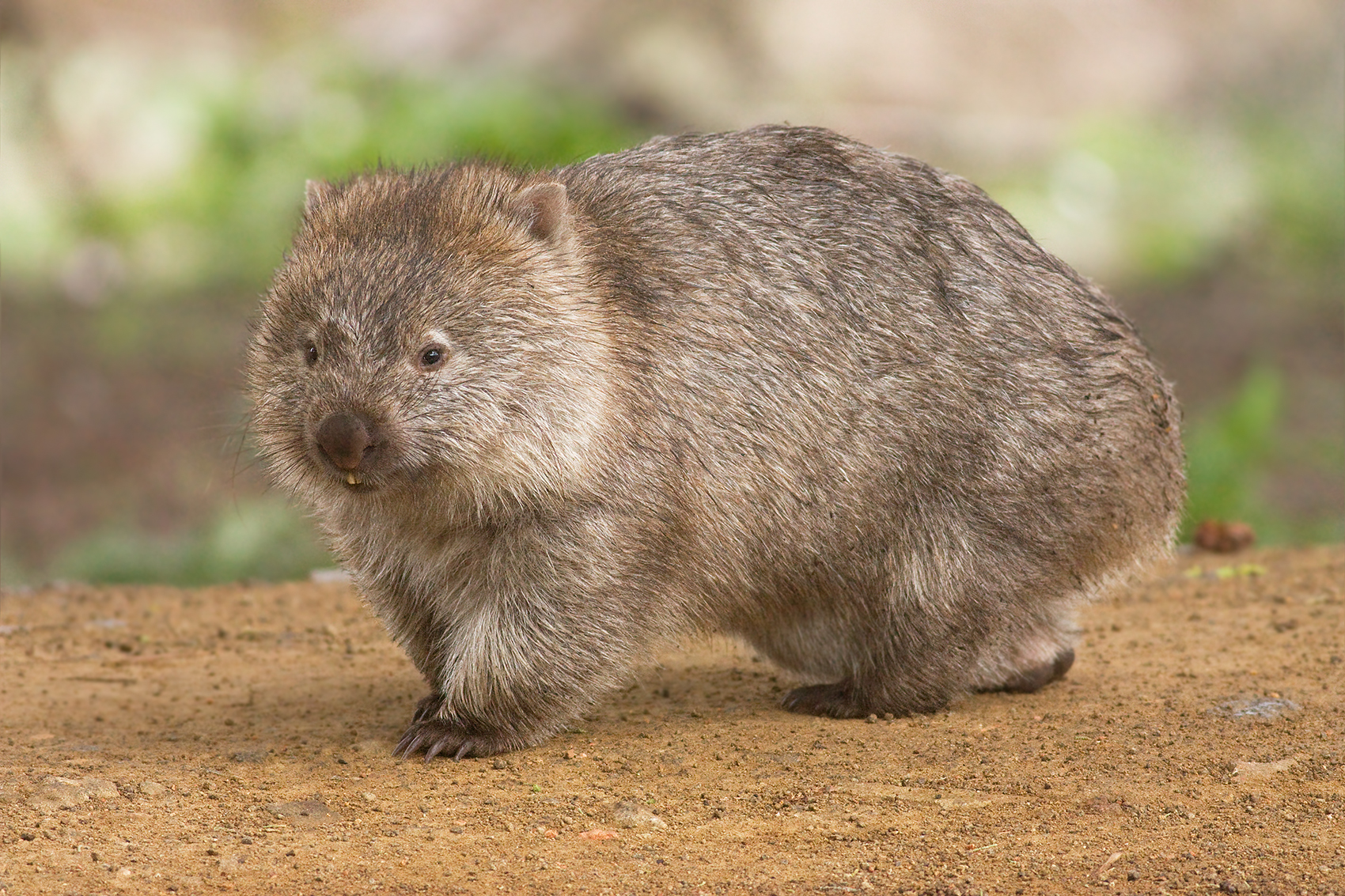
If, that is, the wombats don’t get you first.
The wombat piccie is not mine, it also is from Wikimedia.

No wombats were harmed in the making of this post.

Sunday, January 3, 2010

Road Trip (well sort of)

Most days of the week I drive from my home on the extreme fringes of Melbourne’s sprawl right into the city.

It takes me some time between 25 and 65 minutes, the wide range is all dependent on the traffic. On the whole, because I leave early it takes 35-40 minutes. On weekends, with hardly any other commuters on the road, it is around 25.

Where I live means that the first section of my commute is on what are essentially semi-rural roads.For much of the run I have a single lane each way with the sort of warning signs you might see anywhere in the world.

A school crossing.A sharp corner.

And in keeping with the rural theme a riding school.
Of course if you look around you’ll see plenty of evidence you are on an Aussie road.
A large, flourishing, River Red Gum.
One on its last legs.
Then though a stronger reminder.
We’re in fire danger season (fortunately with recent rain things probably might not be too bad here in Victoria for a few more weeks).

But then you come across a few signs that are unique.
Wildlife warning signs.
Kangaroos.
Wombats.And in case you haven’t yet got the message
Kangaroos and wombats.
And again!
As an aside I have yet to see a wombat on this road, but I have had to take evasive action to spare a kangaroo (and my car, from bitter experience I know Skippies leave big dents).

Anyway if you manage to avoid the pitfalls, our little road feeds into suburban arterial roads.Then a freeway.Before finally exiting onto city streets.
Then we get more signs warning of typically Melbourne hazards
Tram lines which mean
AndThe Safety Zones are designed to protect tram passengers as they climb off.
This sign also warns of another Melbourne curiosity, Hook-Turns, where cars turning right wait in the left lane. All in the name of keeping tram lines clear!

After all this I am only too happy to relax into a day of trying to help the homeless sort out their problems!