
Showing posts with label Marysville. Show all posts
Showing posts with label Marysville. Show all posts
Sunday, May 13, 2012
Waterfall on the Taggerty River


Thursday, December 1, 2011
Three Things
First, those of you who guessed “feathers” hit the nail on the head.
Yesterdays, image was cropped from this piccie of a Laughing Kookaburra, (Dacelo novaeguineae). I
caught photographed this fellow last time I visited my Mum.
These raven sized birds are common on the east coast of Oz. Kookaburras are the largest kingfishers in the world. Unlike most kingfisher species they hunt small animals on the land, including mice and similar-sized small mammals, large insects, lizards, small birds and nestlings, and most famously, snakes.
That reminds me of a funny thing I saw once. (Maybe a tale for another time).
Second, one of my piccies is featuring on Marcy’s MaineWords blog at the moment. Apparently the piccie has inspired her latest WIP! What a lovely thought that one of my piccies has inspired someone else’s writing.
Finally because I want to, two of my recentish piccies.
A mountain stream near Marysville. And Deb and I went to the National Gallery of Victoria last Saturday. I was inspired to practice my own version of art there.

Yesterdays, image was cropped from this piccie of a Laughing Kookaburra, (Dacelo novaeguineae).
 I
These raven sized birds are common on the east coast of Oz. Kookaburras are the largest kingfishers in the world. Unlike most kingfisher species they hunt small animals on the land, including mice and similar-sized small mammals, large insects, lizards, small birds and nestlings, and most famously, snakes.
That reminds me of a funny thing I saw once. (Maybe a tale for another time).
Second, one of my piccies is featuring on Marcy’s MaineWords blog at the moment. Apparently the piccie has inspired her latest WIP! What a lovely thought that one of my piccies has inspired someone else’s writing.
Finally because I want to, two of my recentish piccies.
A mountain stream near Marysville.
 And Deb and I went to the National Gallery of Victoria last Saturday. I was inspired to practice my own version of art there.

Sunday, July 24, 2011
Hunting Part I
Almost twelve months ago I posted about a mountain valley behind Marysville where the forest was destroyed in the 2009 bushfires.
Deb and I went up that way again today
The trees in the Taggerty River Valley still stand like the ghosts they are.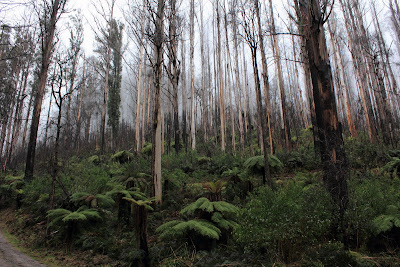 What is changing somewhat is millions of seeds have germinated so saplings are beginning to race for the light between their parents’ skeletons.
We were back because as you know I love photography. One of my favourite subjects is streams and waterfalls.
The drought of previous years is well and truly over and it has rained and rained and rained for what seems like months. The bonus of this is of course waterfalls and rivers are very healthy at the moment.
We wove our way up into the valley along the muddy goat track that serves as a road up there.
It was cold and raining so I was well rugged up. Deb took one look at the weather and elected to sit in the car knitting.
From the valley floor began the climb up this track towards the first waterfall on my hit-list. You get an idea of how rampant the regrowth is.
In the steeper sections there are well made stairs which make the going easier. I paused on this corner for a breather and a piccie. I’d just climbed the stairs down to the right and was about to climb the ones to the left.
Further up I paused again to catch the ghosts of the trees vanishing into the mist (that is the trail and some of the stairs in the right of the frame).
I crossed the stream that forms the falls further up. It's divided here into multiple streamlets that tumble over fern clad boulders.
To give you an idea of how wet it is at the moment a fairy sized waterfall beside the path. Then finally I reached my target the Phantom Falls.
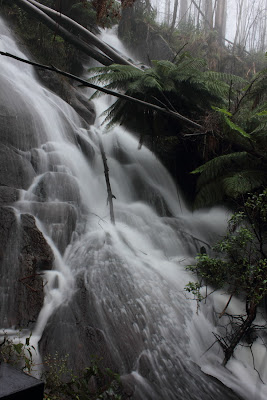 It finally stopped raining as I photographed so I got to wear my hat rather than trying to keep the camera lens dry.
These falls are hard to photograph because to see them you have to get really close. But I think I have done them justice.
Just to make sure a close up.
Deb and I went up that way again today
The trees in the Taggerty River Valley still stand like the ghosts they are.
 What is changing somewhat is millions of seeds have germinated so saplings are beginning to race for the light between their parents’ skeletons.
We were back because as you know I love photography. One of my favourite subjects is streams and waterfalls.
The drought of previous years is well and truly over and it has rained and rained and rained for what seems like months. The bonus of this is of course waterfalls and rivers are very healthy at the moment.
We wove our way up into the valley along the muddy goat track that serves as a road up there.
It was cold and raining so I was well rugged up. Deb took one look at the weather and elected to sit in the car knitting.
From the valley floor began the climb up this track towards the first waterfall on my hit-list.
 You get an idea of how rampant the regrowth is.
In the steeper sections there are well made stairs which make the going easier. I paused on this corner for a breather and a piccie.
 I’d just climbed the stairs down to the right and was about to climb the ones to the left.
Further up I paused again to catch the ghosts of the trees vanishing into the mist
 (that is the trail and some of the stairs in the right of the frame).
I crossed the stream that forms the falls further up.
 It's divided here into multiple streamlets that tumble over fern clad boulders.
To give you an idea of how wet it is at the moment a fairy sized waterfall beside the path.
 Then finally I reached my target the Phantom Falls.
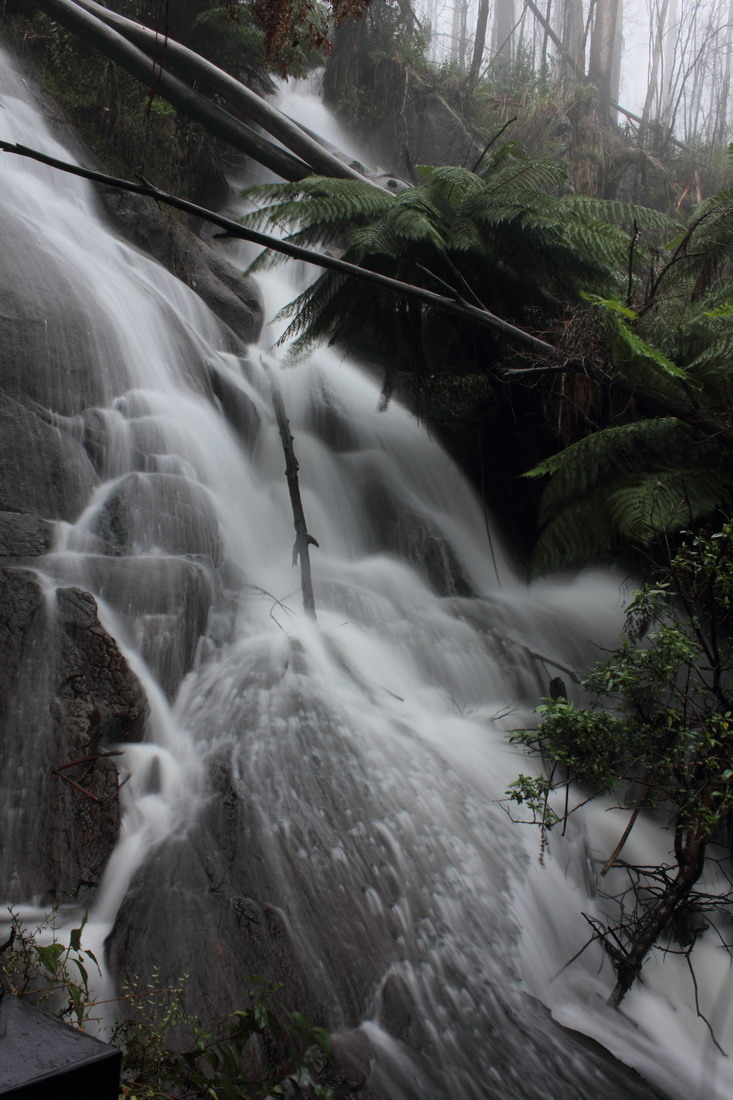 It finally stopped raining as I photographed so I got to wear my hat rather than trying to keep the camera lens dry.
These falls are hard to photograph because to see them you have to get really close. But I think I have done them justice.
Just to make sure a close up.

Wednesday, August 25, 2010
Ghosts
You’ll have to forgive me but the tone of this post is a bit somber.
On Saturday Deb and I went for one of our weekend drives.
As so often happens we drove out into the mountains to the east of Melbourne.
We decided to head up to Lake Mountain to see how the snow is going in the tail end of the season.
The road to Lake Mountain passes through Marysville which was devastated in the Black Saturday bushfires back in February last year. Across the state of Victoria 173 people perished in the fires.
We paused in a valley behind Marysville where I grabbed these piccies.
What was a lush valley of Mountain Ash trees is a stark graveyard of greying ghosts. The reason these trees are grey is after the fires the burnt bark has fallen from those that have died.
 The trees covered in a green fuzz in this piccie are the ones that pulled through the fire. Normally after a bushfire you would see the bush bouncing back and all the trees except a few would have come through. These fires were just too hot.
Back on the main road we drove further up the valley.
In places low clouds softened the ridge-lines covered in dead trees. The Aussie bush is not deciduous, these trees are bare not because of winter but because they have perished.
 Finally on the high ridges ahead we saw what we had come for: Snow

On Saturday Deb and I went for one of our weekend drives.
As so often happens we drove out into the mountains to the east of Melbourne.
We decided to head up to Lake Mountain to see how the snow is going in the tail end of the season.
The road to Lake Mountain passes through Marysville which was devastated in the Black Saturday bushfires back in February last year. Across the state of Victoria 173 people perished in the fires.
We paused in a valley behind Marysville where I grabbed these piccies.
What was a lush valley of Mountain Ash trees is a stark graveyard of greying ghosts.
 The reason these trees are grey is after the fires the burnt bark has fallen from those that have died.
 The trees covered in a green fuzz in this piccie are the ones that pulled through the fire. Normally after a bushfire you would see the bush bouncing back and all the trees except a few would have come through. These fires were just too hot.
Back on the main road we drove further up the valley.
In places low clouds softened the ridge-lines covered in dead trees. The Aussie bush is not deciduous, these trees are bare not because of winter but because they have perished.
 Finally on the high ridges ahead we saw what we had come for: Snow

Sunday, November 29, 2009
Rain, Fire and a Fatty
We have been having rain, glorious rain for the past week. Thank goodness it held off while we were actually moving.
After ten years of drought it is desperately needed. Melbourne’s water storages are creeping up slowly. An added benefit is that rain now will delay the risk of fire this summer. Unfortunately, government sources are suggesting that the risks of the current fire season are as high as past summer.
Now you have to forgive me I am going to be a little morbid for a moment. Further north the fire season has started early. In NSW as I type there are 50 wildfires burning across the state. My brother is a Rural Fire Service Brigade Captain on the NSW Central Coast. His brigade was called out to 22 scrub fires in just the past month. And it is still only spring.
We drove across the back road through Marysville towards Warburton. This area around Marysville was some of the most badly burnt in the Black Saturday Fires on this 7th February past. I posted about the devastation through this way a while ago.
This time the weather was clear and we could look across the valleys to distant ridges. In some places your eye was drawn to the green patches in the valleys below (green thanks to the recent rain) and things did not seem too bad. But when you looked at the closer ridgelines you really realised how extreme the conditions were.

These few photos show a mountainside totally destroyed. All the trees seem to have perished in the heat. Something almost unheard of in the Aussie bush, our eucalyptus trees are tough as nails. Also many of the trees seem to have been felled as if in a wind generated by a raging fire-storm.
 These destroyed mountainsides remind me of the destruction caused by the eruption of Mount Saint Helens back in 1980. Like there I think the forest will be decades in regenerating.
All we can hope is we don’t see such conditions again this coming summer.
Enough of doom and gloom.
Not far from these scenes of destruction there is an untouched patch of bush along Badger’s Creek. In there I managed the rare treat of photographing this fat little fellow. He (and I know he is a he because of his colouration) is a Common Bronzewing, a native pigeon species. Although they are, as the name suggests, quite common they are also shy and will not often sit long enough to have their portrait taken.
They are quite gaudily coloured birds and the wing feathers are a metallic sheen that change colour depending on the angle the light strikes them. The first photo only kind of shows the variation because he is in the shade.
 This second piccie is not such a good shot. He insisted on turning his back (I said they are shy!) but it does show just how brilliantly metallic those feathers are.
After ten years of drought it is desperately needed. Melbourne’s water storages are creeping up slowly. An added benefit is that rain now will delay the risk of fire this summer. Unfortunately, government sources are suggesting that the risks of the current fire season are as high as past summer.
Now you have to forgive me I am going to be a little morbid for a moment. Further north the fire season has started early. In NSW as I type there are 50 wildfires burning across the state. My brother is a Rural Fire Service Brigade Captain on the NSW Central Coast. His brigade was called out to 22 scrub fires in just the past month. And it is still only spring.
We drove across the back road through Marysville towards Warburton. This area around Marysville was some of the most badly burnt in the Black Saturday Fires on this 7th February past. I posted about the devastation through this way a while ago.
This time the weather was clear and we could look across the valleys to distant ridges. In some places your eye was drawn to the green patches in the valleys below (green thanks to the recent rain) and things did not seem too bad.
 But when you looked at the closer ridgelines you really realised how extreme the conditions were.

These few photos show a mountainside totally destroyed. All the trees seem to have perished in the heat.
 Something almost unheard of in the Aussie bush, our eucalyptus trees are tough as nails. Also many of the trees seem to have been felled as if in a wind generated by a raging fire-storm.
 These destroyed mountainsides remind me of the destruction caused by the eruption of Mount Saint Helens back in 1980. Like there I think the forest will be decades in regenerating.
All we can hope is we don’t see such conditions again this coming summer.
Enough of doom and gloom.
Not far from these scenes of destruction there is an untouched patch of bush along Badger’s Creek. In there I managed the rare treat of photographing this fat little fellow.
 He (and I know he is a he because of his colouration) is a Common Bronzewing, a native pigeon species. Although they are, as the name suggests, quite common they are also shy and will not often sit long enough to have their portrait taken.
They are quite gaudily coloured birds and the wing feathers are a metallic sheen that change colour depending on the angle the light strikes them. The first photo only kind of shows the variation because he is in the shade.
 This second piccie is not such a good shot. He insisted on turning his back (I said they are shy!) but it does show just how brilliantly metallic those feathers are.
Friday, October 2, 2009
Fire, Snow and Rain.
On Sunday, after I posted about Greg and Fred, we went for a drive. Most of the photos in this post were taken from the front passenger seat of our moving car. As you will see from the photos it was wet most of the way.
We drove out through Healesville in the Yarra Valley up over the Black Spur.
The bush here was burnt in the fires following Black Saturday, 7th February 2009.
 This first piccie shows the bush there; it is deceptively green. Unlike the fires on the 7th most of the fire up through this stretch was of low intensity. The tree trunks are blackened, but the crowns of the trees were not harmed and with the tree ferns sprouting in the understory it looks comparatively healthy.
Up over the Black Spur we turned off the Maroondah Highway and drove up towards Marysville. This second photo shows a stretch that was burnt on the Black Saturday. The crowns of the trees have been burnt bare and killed and the understory burnt away completely.
Virtually all these trees are Eucalyptus species (gum trees in daily usage) as Australian natives they are well adapted to fire and most of them are still alive, although badly damaged.
 Marysville was one of the hardest hit places on Black Saturday, about one in five of the townspeople perished and the majority of buildings were destroyed. I didn’t take any photos there, it felt disrespectful.
Past Marysville we drove higher up past Lake Mountain towards Warburton in the Upper Yarra.
This photo shows how stark the landscape is up there now. The fires were truly intense, most of these trees are showing no sign of regeneration. To kill Eucalypts like this the fires were probably over 1000 degrees centigrade.
 It was a bitterly cold day and in this higher country snow had been falling. Again most of the trees in these next few photos appear to have perished.


 As we went father up the snow got deeper and the contrast between the blackened trees and the white of the snow is marked. The only green was from a few tree ferns that were just hanging on.

Then a sudden contrast we drove into a small pocket of bush that had avoided the worst of the fire. It’s not a great photo but it gives you an idea of what this bush would normally like at this time of year. Aussie bush is evergreen, so usually we have snow and leafy trees together.
 Then back into burnt. This bush is burnt but with less ferocity. I think many of these trees will come back. I quite like these couple of photos, the black of the trunks, the white snow and the wet windscreen blurring it all together.


As you can see it began to lightly snow again.

Driving in snow is not something we have to do in most of the country.
Finally as we came back down the other side bush untouched by the fires. Also more rain. Glorious rain. Enough to cause some nuisance flooding and even lift Melbourne’s water supply by a few percent.
We drove out through Healesville in the Yarra Valley up over the Black Spur.
The bush here was burnt in the fires following Black Saturday, 7th February 2009.
 This first piccie shows the bush there; it is deceptively green. Unlike the fires on the 7th most of the fire up through this stretch was of low intensity. The tree trunks are blackened, but the crowns of the trees were not harmed and with the tree ferns sprouting in the understory it looks comparatively healthy.
Up over the Black Spur we turned off the Maroondah Highway and drove up towards Marysville. This second photo shows a stretch that was burnt on the Black Saturday. The crowns of the trees have been burnt bare and killed and the understory burnt away completely.
Virtually all these trees are Eucalyptus species (gum trees in daily usage) as Australian natives they are well adapted to fire and most of them are still alive, although badly damaged.
 Marysville was one of the hardest hit places on Black Saturday, about one in five of the townspeople perished and the majority of buildings were destroyed. I didn’t take any photos there, it felt disrespectful.
Past Marysville we drove higher up past Lake Mountain towards Warburton in the Upper Yarra.
This photo shows how stark the landscape is up there now. The fires were truly intense, most of these trees are showing no sign of regeneration. To kill Eucalypts like this the fires were probably over 1000 degrees centigrade.
 It was a bitterly cold day and in this higher country snow had been falling. Again most of the trees in these next few photos appear to have perished.


 As we went father up the snow got deeper and the contrast between the blackened trees and the white of the snow is marked. The only green was from a few tree ferns that were just hanging on.

Then a sudden contrast we drove into a small pocket of bush that had avoided the worst of the fire. It’s not a great photo but it gives you an idea of what this bush would normally like at this time of year. Aussie bush is evergreen, so usually we have snow and leafy trees together.
 Then back into burnt. This bush is burnt but with less ferocity. I think many of these trees will come back. I quite like these couple of photos, the black of the trunks, the white snow and the wet windscreen blurring it all together.


As you can see it began to lightly snow again.

Driving in snow is not something we have to do in most of the country.
Finally as we came back down the other side bush untouched by the fires. Also more rain.
 Glorious rain. Enough to cause some nuisance flooding and even lift Melbourne’s water supply by a few percent.
Subscribe to:
Posts (Atom)