Showing posts with label Port Arthur. Show all posts

Friday, June 8, 2012

Hell on Earth

A few days ago I posted about Walhalla with the throw away title of “Al goes to Heaven”.
Well tonight I am talking about another spectacularly beautiful place that was once quite simply hell for those who lived, worked and often died there.
Down in Tasmania on the spectacularly beautiful Tasman Peninsula, not far from the world famous ruins of Port Arthur lies another set of Convict Era ruins.
Approaching the ruins today, you walk through peaceful bushland, then quite suddenly you come into open ground and up on a mound to one side you see this.

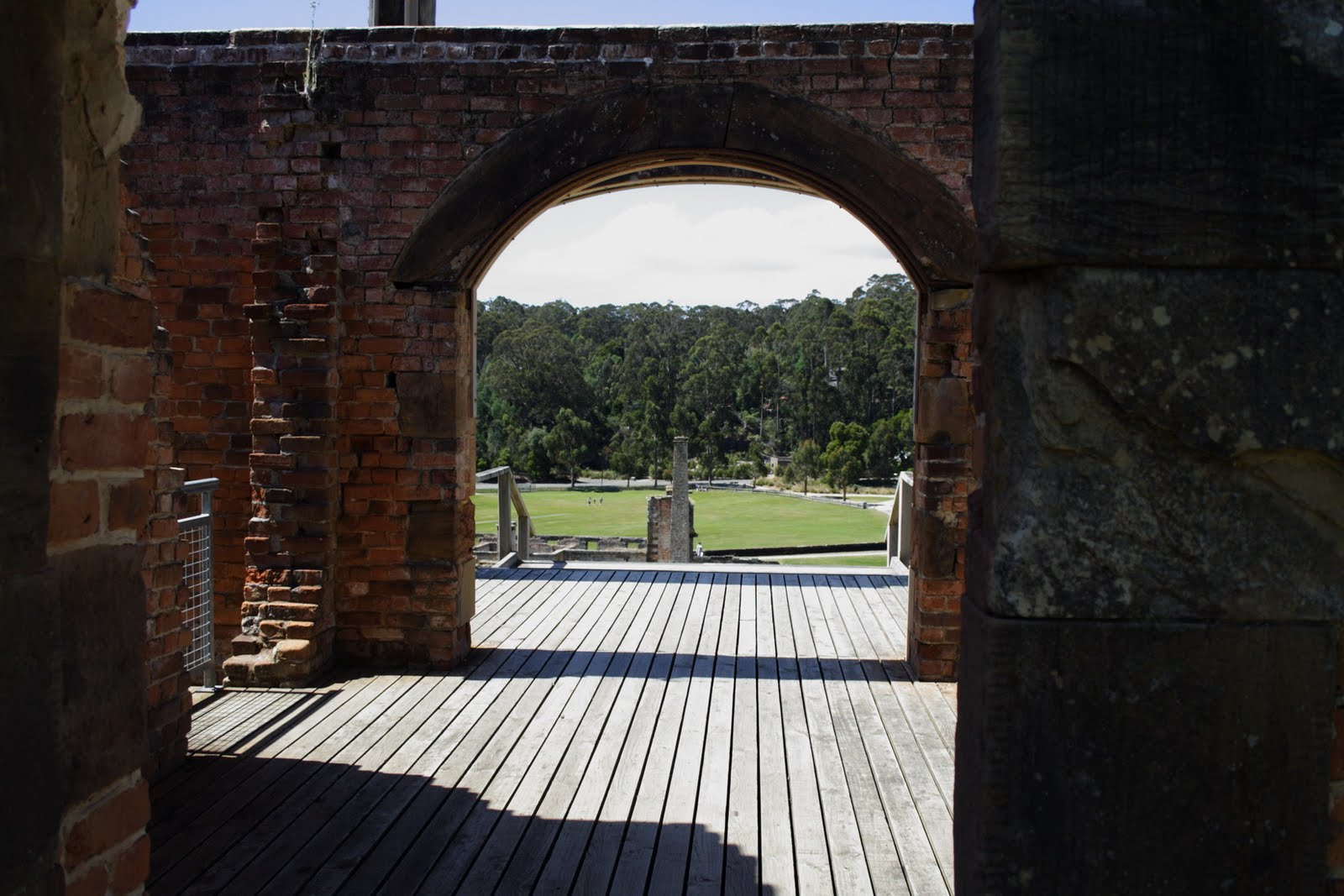
Following the path around you come up onto the platform that once formed the parade ground of the settlement that was here.
It is eerily beautiful, and I had a great time catching angles:
 
From inside the bakehouse

Across the ground to a barrack house
 
And looking through the remains of the hospital you get a hint of just how spectacular the scenery around here is.
 
But just a short stroll up the hill beneath what was a brick built guard house is a pointer to how terrible this place was.
Because, you see, this location is known as “The Convict Coal Mines”
The prisoners here had been sent from England, Ireland, Scotland, and Wales to the far ends of the Earth.
For some convicts life in Oz was not in the end too bad. Once they served their sentence they really did have a chance at a new life.
But the prisoners who came here came to a real hell.
Coal mines anywhere in the 19th century were terrible. But to add to that these men were not skilled miners, but in most cases unskilled prisoners from the slums of the UK.
They slaved underground in the most abysmal conditions driven on by the usual punishments of the day, floggings and the like.
But there was an extra punishment for those who the system chose to break.
I am guilty of misdirection with my tales of treasury vaults last night.

Those of you who said a vaulted ceiling were right.
Because under that guardhouse were the punishment cells
This passage gives a hint of how dark this space was. Bear in mind that where the light is pouring in today was once below ground in a prison cellar, the ceiling at the far end has collapsed.

Here is a piccie of one of the cells. It is just long enough for me to lie down. I had to duck to get under this ceiling and the width is just a little more than my shoulders.
 
It only looks light because I had to use a flash to get this shot. Without it I could not see the end even with the light from the hall. The only positive thing about them is even as a ruin they are dry.
As a punishment, men were locked in these spaces for days and sometimes weeks at a time in the pitch dark. And when they were let out it was only to face another round down the mine.
Above is so beautiful today it is quite sobering to see this evidence of just what a hell this place was.

Wednesday, March 9, 2011

Tassie Again: Day 6 Continued

Believe it or not this is my third post on our sixth day in Tassie.
We packed so much in on that day it is hard to believe in retrospect.

Our primary destination for the day was the ruined Convict town Port Arthur.

Port Arthur began life in 1830 as a timber cutting settlement. But from 1833 until the 1850s it served as a convict settlement taking prisoners transported from Britain and Ireland and re-offenders from the Australian colonies.

It was an incredibly harsh environment to which convicts dreaded being sent. There are stories of prisoners with life sentences deliberately committing murders to find away out via the gallows.

Transportation of convicts to Tasmania ceased in 1853 and from then until 1877 the town continued to function as a prison.
The prison closed in 1877 and the government tried to sell off the property. Soon after the first of a series of devastating bushfires tore through the site and it was essentially abandoned.

From the 1890s tourists began journeying to Port Arthur to see the ruins.
In 2010 the town was listed by UNESCO as a World Heritage Site.

Now the potted history is done the piccies. I have had huge issues sorting which piccies to use for this post as I took about 500 while I was at Port Arthur.

Our first sight of the ruins was across the green to the original prison. It was initially built as a flour mill and store but was soon converted to the prison. Like all the buildings in the town it was built using convict labour.This building just gets more impressive the closer you get. I love the effect of looking through arches and doorways in piccies; this is the tower at the front of the prison.Swinging around the end of the prison you get an idea of how extensive and multilayered the site is.Behind the prison is the officers’ quarters.Dominating the high ground behind is the “Guard House.”And from behind looking down over the bay.The interior of the guardhouse is original as it was one of the few buildings not destroyed in the bushfires. Once again I had fun trying to get decent shots through the building.Directly behind the prison is the hospital.This building was extensively damaged in the first fires.
The government gave it to the Catholic Church to use as a boys’ home.

This photo from the 1880s shows the hospital as it was being repaired.
Another fire left it as it is today.
I played with shots of the hospital’s archways from different angles. From outside:And inside:The north side of the hospital.And below it this massive dry-stone granite retaining wall.We then went for a short ferry ride around the bay.

This is the isle of the dead. It was used as the cemetery of the settlement. There are 1646 graves recorded to exist there, only 180 were marked. Prison staff and military personnel and their families had regular headstones. The convicts were buried in unmarked graves, not even in death was their humanity recognised.

Heading back to the harbour I took some shots from the vantage point of those arriving in the 1800s.A hallway in the "guest house".And last of all I visited the church

Again from inside:and outside: