We packed so much in on that day it is hard to believe in retrospect.
Our primary destination for the day was the ruined Convict town Port Arthur.
Port Arthur began life in 1830 as a timber cutting settlement. But from 1833 until the 1850s it served as a convict settlement taking prisoners transported from Britain and Ireland and re-offenders from the Australian colonies.
It was an incredibly harsh environment to which convicts dreaded being sent. There are stories of prisoners with life sentences deliberately committing murders to find away out via the gallows.
Transportation of convicts to Tasmania ceased in 1853 and from then until 1877 the town continued to function as a prison.
The prison closed in 1877 and the government tried to sell off the property. Soon after the first of a series of devastating bushfires tore through the site and it was essentially abandoned.
From the 1890s tourists began journeying to Port Arthur to see the ruins.
In 2010 the town was listed by UNESCO as a World Heritage Site.
Now the potted history is done the piccies. I have had huge issues sorting which piccies to use for this post as I took about 500 while I was at Port Arthur.
Our first sight of the ruins was across the green to the original prison. It was initially built as a flour mill and store but was soon converted to the prison. Like all the buildings in the town it was built using convict labour.
 This building just gets more impressive the closer you get.
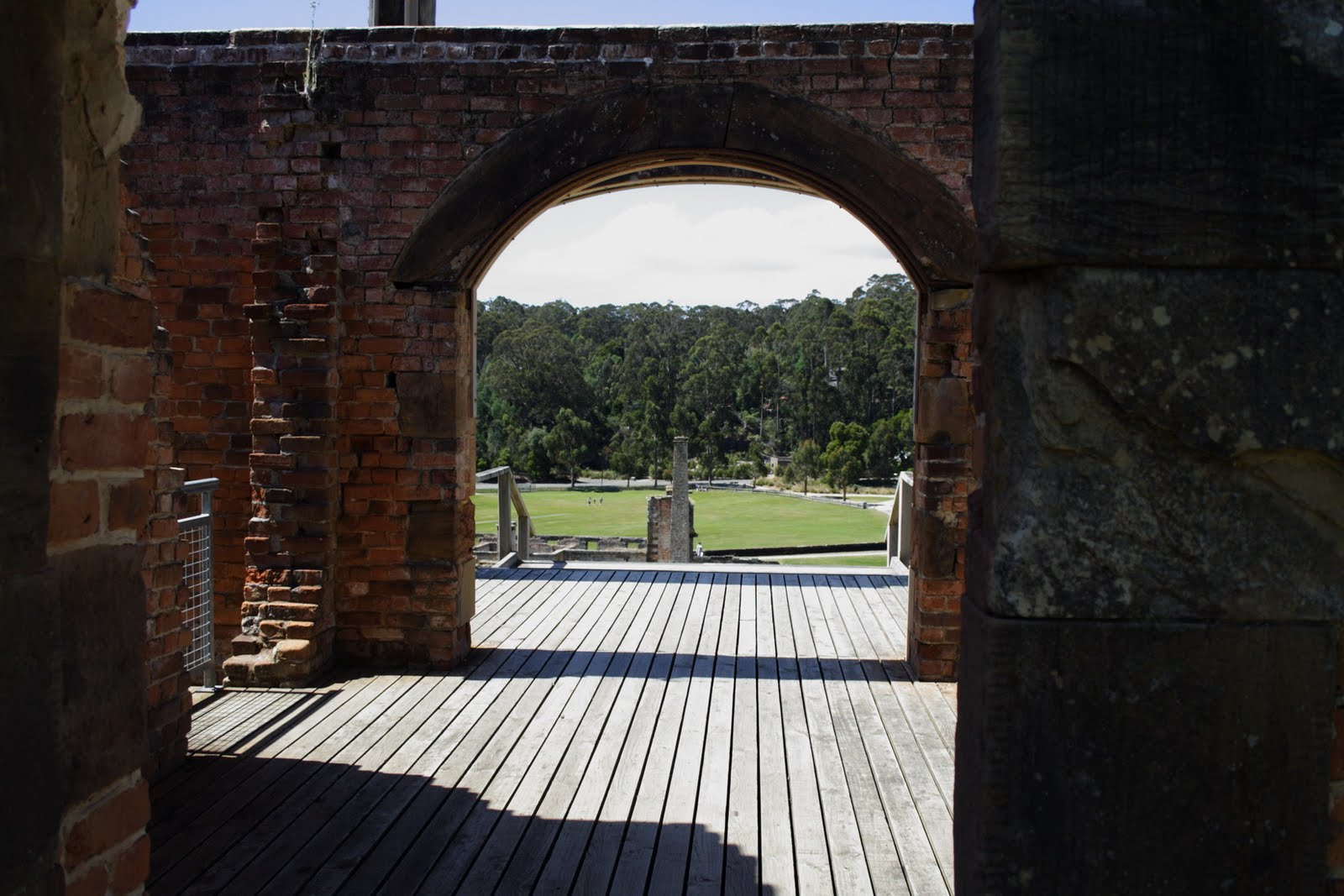
 I love the effect of looking through arches and doorways in piccies; this is the tower at the front of the prison.
 Swinging around the end of the prison you get an idea of how extensive and multilayered the site is.
 Behind the prison is the officers’ quarters.
 Dominating the high ground behind is the “Guard House.”
 And from behind looking down over the bay.
 The interior of the guardhouse is original as it was one of the few buildings not destroyed in the bushfires. Once again I had fun trying to get decent shots through the building.
 Directly behind the prison is the hospital.
 This building was extensively damaged in the first fires.
The government gave it to the Catholic Church to use as a boys’ home.
This photo from the 1880s shows the hospital as it was being repaired.
 Another fire left it as it is today.
I played with shots of the hospital’s archways from different angles. From outside:
 And inside:
 The north side of the hospital.
 And below it this massive dry-stone granite retaining wall.
 We then went for a short ferry ride around the bay.
This is the isle of the dead.
 It was used as the cemetery of the settlement. There are 1646 graves recorded to exist there, only 180 were marked. Prison staff and military personnel and their families had regular headstones. The convicts were buried in unmarked graves, not even in death was their humanity recognised.
Heading back to the harbour I took some shots from the vantage point of those arriving in the 1800s.
 A hallway in the "guest house".
 And last of all I visited the church
Again from inside:
 and outside:


